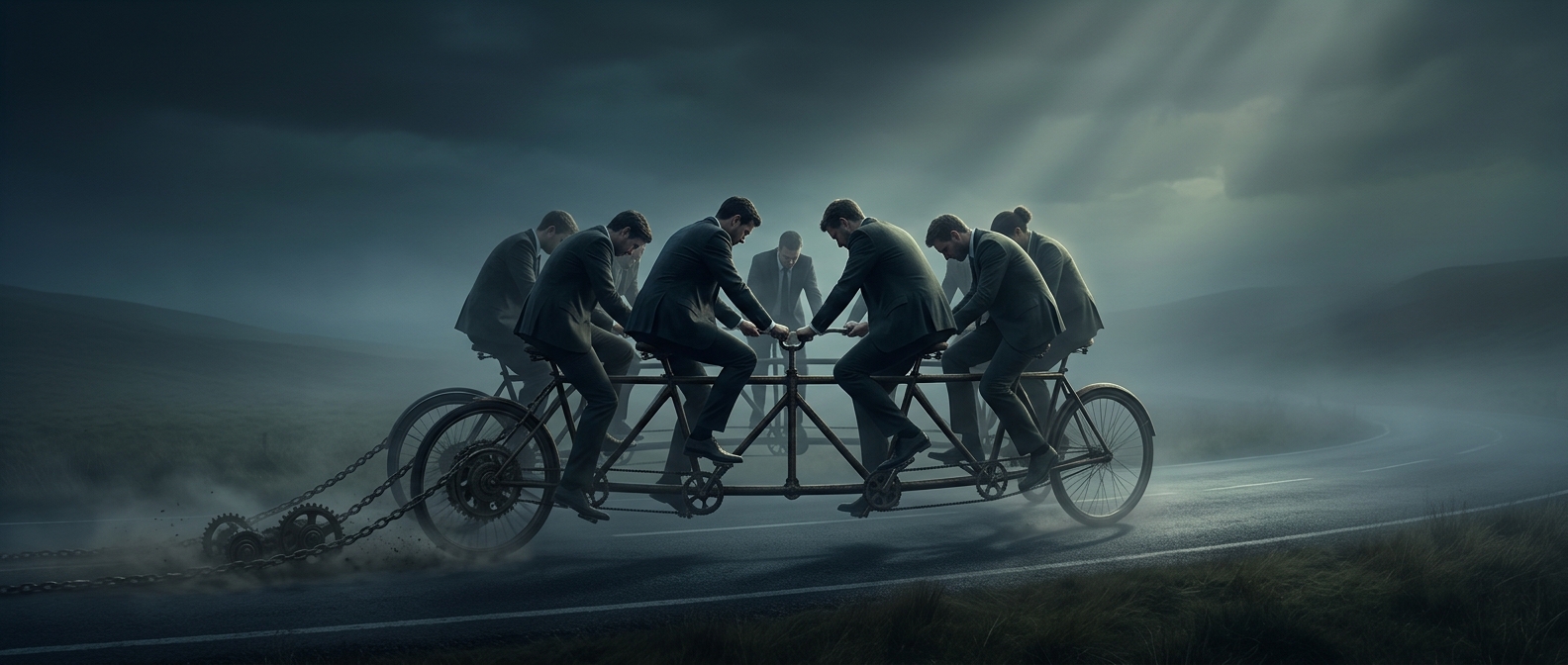
A ride built around shared effort
On a conventional bicycle, the rider who steers also supplies the power. On this group bike, those jobs are separated: one person controls direction while several riders contribute through their own pedals. That arrangement makes the vehicle less like a row of independent bicycles and more like a small team operating one machine.
The distinction matters because pedaling does not automatically mean everyone is moving at the same pace. Riders may vary in strength, rhythm, or willingness to work, but they are attached to the same moving vehicle. The group’s progress therefore depends on cooperation, while the person steering has to guide the whole assembly rather than simply choose a personal line.
Conversation becomes part of the design
Facing inward changes what riders can do while moving. Instead of looking only at the road or the back of another cyclist, they can see one another and talk. That makes the bike suited to outings where the ride itself is meant to be social, not merely a way to get from one place to another.
It also creates a practical tradeoff: a vehicle carrying several people needs room to maneuver and a clear agreement about who is steering and how much effort the group is contributing. The unusual seating is not just a novelty; it makes the ride’s central fact visible. Everyone shares the motion, but not everyone has the same control over it.