Why a Hand on the Wall Can Lead Out
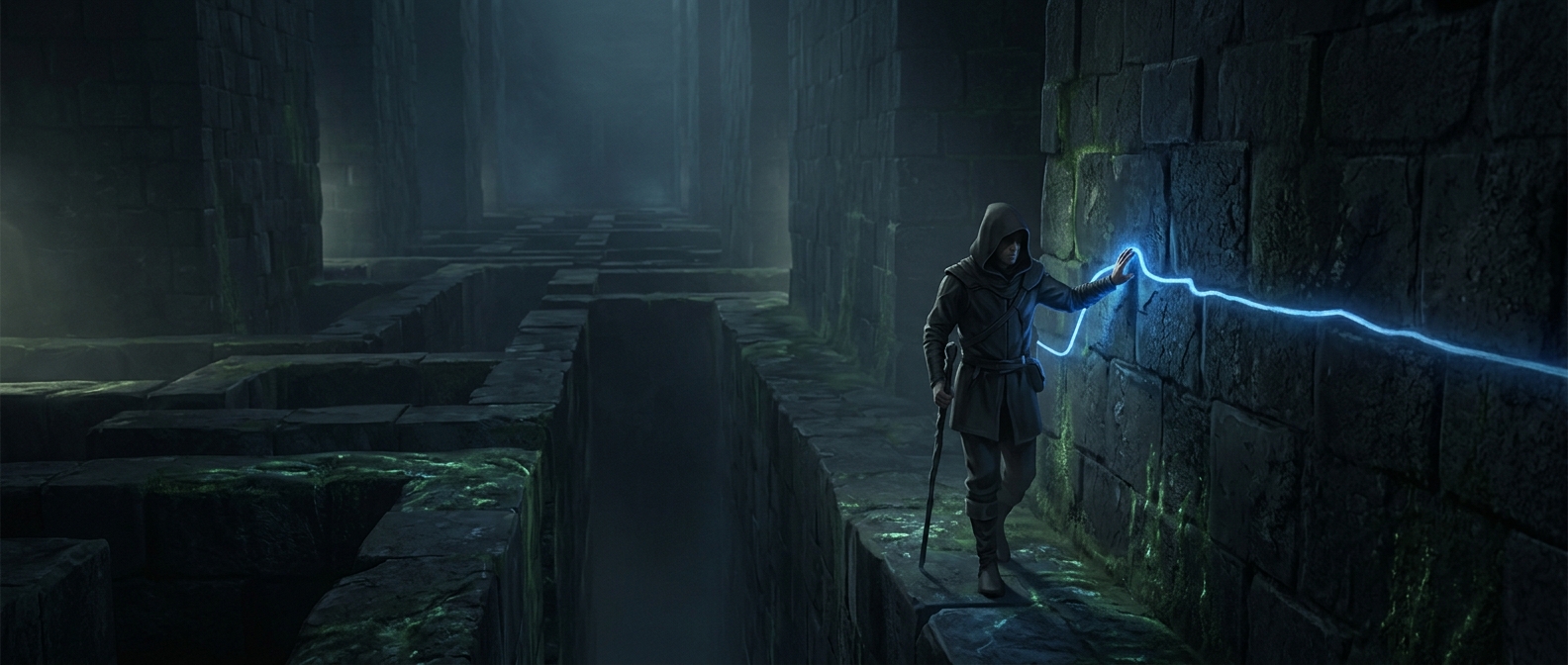
A maze’s passages may look like a branching puzzle, but the wall-following trick turns the task into tracing a boundary. Keep one hand against a wall and move forward whenever you can; when the wall turns, follow the turn without switching hands. At each junction, the wall itself tells you which passage continues along its edge, so you do not need to remember earlier choices.
This works reliably when the maze has a simple layout: its walls do not form isolated islands or loops that separate parts of the passage network. In that kind of maze, the wall you are tracing ultimately connects to the maze’s outer boundary. Follow it far enough, and you can reach an exit on that boundary.
When the Trick Can Fail
A maze can be connected—all its passages link together—and still contain loops or wall islands. In such a design, the hand may trace one closed boundary and bring you back to where you started. The rule has not lost its place; it is faithfully following a boundary that never reaches the exit. It can also fail if you begin deep inside a maze, rather than at an entrance on the outside edge.
That is why wall-following is a dependable method for many traditional mazes, but not a guarantee for every maze described as connected. The key is not simply whether every passage links up; it is whether the wall you follow belongs to a boundary that reaches the exit. In a suitable maze, a steady hand replaces a mental map with one simple question at every step: where does this same wall go next?