Why a Tax Could Be Paid in a Wheel of Cheese
A tax did not always mean handing over coins. In medieval economies, many people produced food but had limited access to cash, especially outside busy markets. A demand payable in goods let authorities collect value from households whose wealth was tied up in what they grew or made.
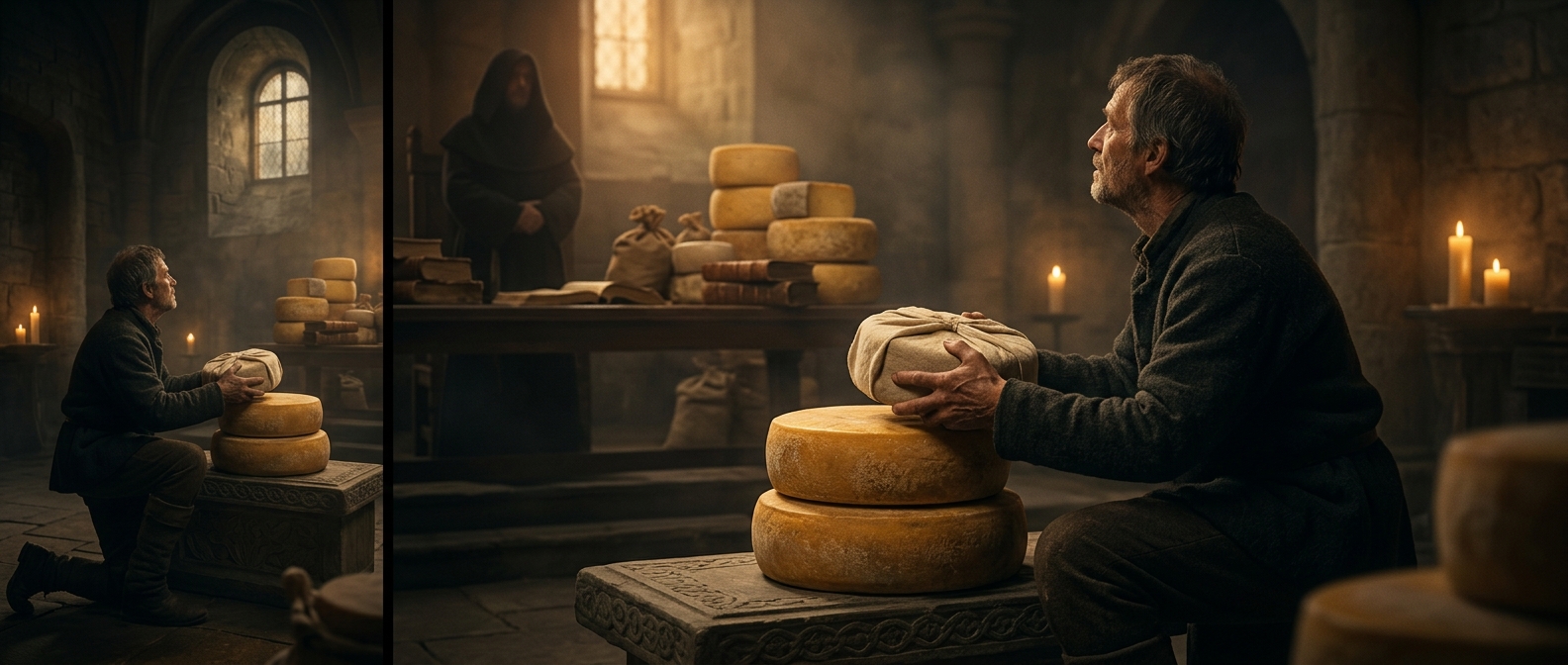
Cheese was useful for this arrangement because milk could be turned into a more durable food. Fresh milk spoiled quickly; a wheel of cheese could be kept and moved, making it a more practical payment than a bucket of milk. The wheel was not a token portion: it represented a substantial amount of work and dairy production.
A Food Payment Still Had an Economic Value
An in-kind tax—payment in goods rather than money—shifted part of the work of collecting revenue onto the household. The payer had to produce the required cheese, while the recipient had to accept, store, use, or pass it on. Such payments made sense when local production was easier to obtain than coins, though they also meant the authority received a particular product rather than freely spendable cash.
The obligation could be recorded as a quantity of cheese, turning an everyday food into a unit of dues. Its size makes the arrangement tangible: a tax claim could reach right into a household’s dairy stores, taking not a bite, but an entire wheel.