The Envelope Turns Every Card Into Evidence
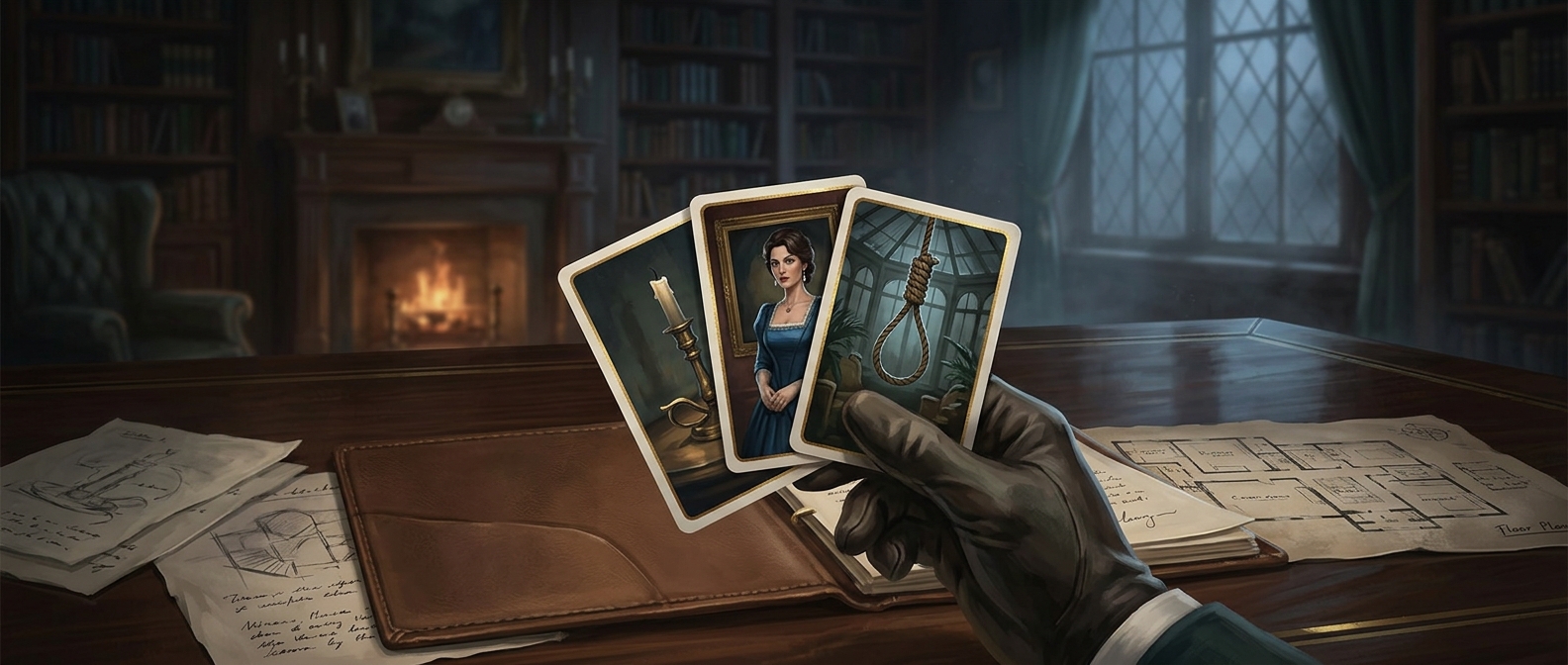
Clue’s mystery is built around a compact deduction problem: one suspect card, one weapon card, and one room card are removed from the deck and sealed away. The remaining cards are dealt to players. Because the envelope’s contents are drawn from the same categories as the cards in players’ hands, each card a player holds is ruled out as part of the solution.
That makes ordinary game actions do double duty. A guess is not just a proposed answer; it is a test of three possibilities at once. When another player can answer by showing a matching card, the guesser learns that at least one of those possibilities is not in the envelope.
A Private Reveal Creates Public Clues
The reveal is usually private: the player answering shows one matching card to the guesser, not to the whole table. Everyone else can see that someone answered, but not which card they saw. The guesser gains direct evidence; the other players must reason from the pattern of guesses and responses instead.
If nobody can answer a particular guess, that is especially informative. It suggests that the named suspect, weapon, and room may all be among the hidden cards—unless a player’s earlier information already rules one out. Players keep track of what they know, what others may hold, and which combinations have not been disproved.
Why the Deduction Stays Social
The game does not hand each player a complete, orderly set of clues. Information arrives unevenly, and a player may have to choose which matching card to reveal when several could answer a guess. That choice can protect useful information or mislead opponents about what is still possible, even without changing the cards in the envelope.
The result is a mystery solved through both elimination and observation. A player’s best move may be less about making a dramatic accusation than asking a carefully chosen question—and noticing who can answer it. The final accusation is strongest when the envelope is the only place the three surviving possibilities can still fit.