Why a small hump can deliver a hard jolt
A speed bump works by forcing a vehicle’s wheels to rise and fall over a short distance. At low speed, the suspension—the springs and dampers that let the wheels move without shaking the whole vehicle—can absorb much of that change. Hit the same hump faster, and the wheels have less time to climb it smoothly. The suspension compresses and rebounds more abruptly, sending a sharper jolt through the car.
The hump is therefore a physical demand, not just a visual reminder. Drivers have to slow down to make the crossing comfortable and keep the vehicle under control. The same geometry that discourages speeding can also be felt by someone who was already driving carefully.
One shape, many different vehicles
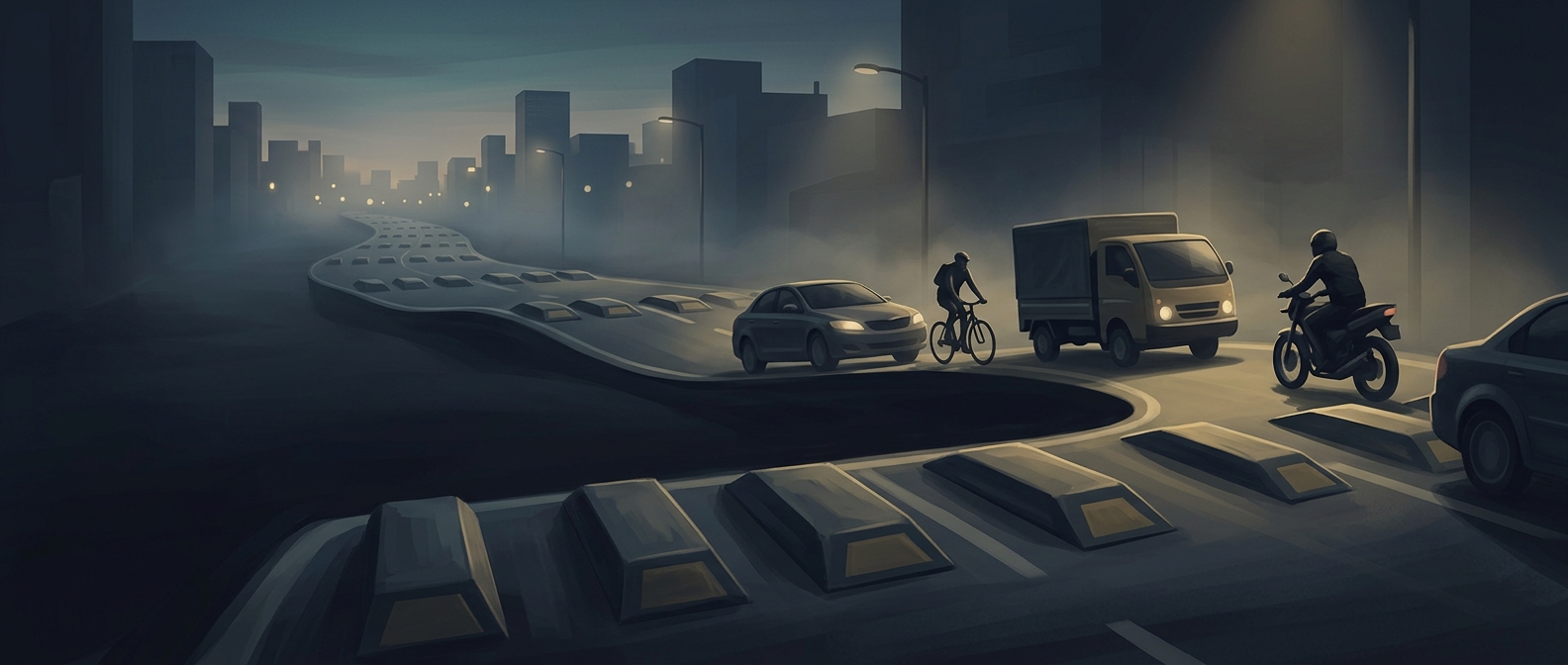
A bump cannot distinguish a speeding car from a bus, an ambulance, or a low-riding vehicle. Each meets the same raised pavement, but wheel size, suspension, ground clearance, and vehicle load affect how the crossing feels. A long-wheelbase vehicle may straddle the hump differently from a compact car; a vehicle with little clearance risks scraping if the profile is too abrupt or it crosses at an unsuitable angle.
That is the tradeoff in the design: make the obstacle pronounced enough to encourage slower driving, but not so severe that ordinary, careful crossings become unnecessarily harsh. A longer, flatter raised feature—often called a speed table—spreads the climb over more pavement and can make the transition gentler, though it still requires vehicles to rise and descend.
The warning is built into the road
Signs ask drivers to change speed; a raised surface makes speed physically noticeable. That directness is why the device can work—and why its effects reach every vehicle that passes over it. The road is enforcing caution through the suspension, one crossing at a time.