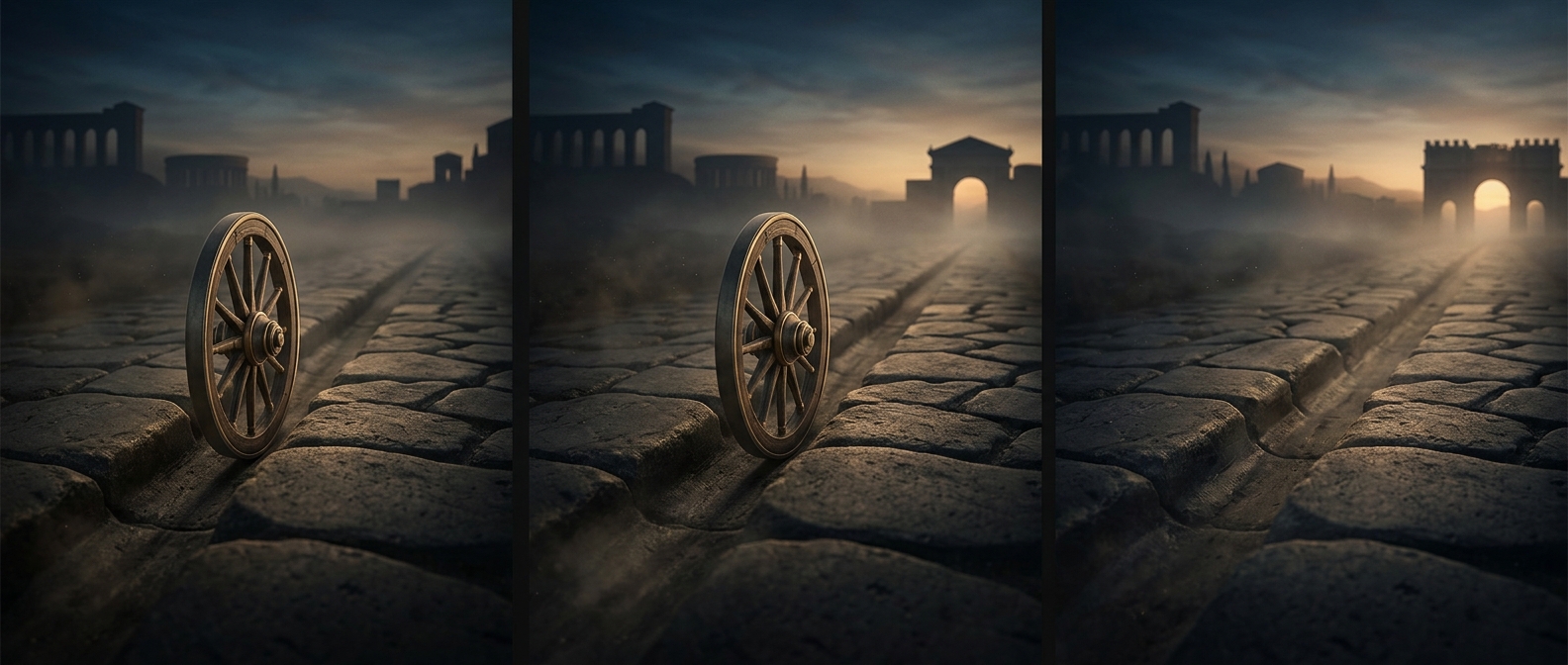
Why matching cart widths mattered on Roman roads
The important measurement was a cart’s track width: the distance between its left and right wheels. “Wheelbase” usually means the distance between the front and rear axles. On heavily traveled roads, repeated wheel traffic could wear parallel grooves into the stone or packed surface. A cart whose wheels matched the spacing of those grooves could roll along them instead of constantly climbing out and back in.
Grooves could guide a cart—and constrain it
A pair of ruts acted like shallow rails. They helped keep a loaded cart moving straight, especially over uneven ground, and reduced the sideways jolts that came from wandering across a rough road. But the benefit depended on fit. If the wheels were too close together or too far apart, they could ride awkwardly against the rut edges or fail to follow the grooves at all.
That made compatible track widths useful wherever many carts shared a route. A driver did not need a specially engineered road for each vehicle: once traffic had worn a pair of tracks, later carts of similar width could use them. The road’s surface thus favored carts built to fit the paths previous wheels had made.
A practical pattern, not a perfect system
This was a feedback loop between vehicles and roads: carts wore grooves, and the grooves rewarded carts that could follow them. It did not mean every Roman cart everywhere had identical dimensions, or that every road had the same ruts. Road surfaces, traffic, and local needs varied. But on a busy, grooved stretch, matching the established track width could turn an irregular route into a more predictable one.
The striking consequence is that a road could shape the vehicles using it. Once deep grooves formed, choosing a different wheel spacing was not just a matter of cart design—it could mean fighting the road with every turn of the wheels.