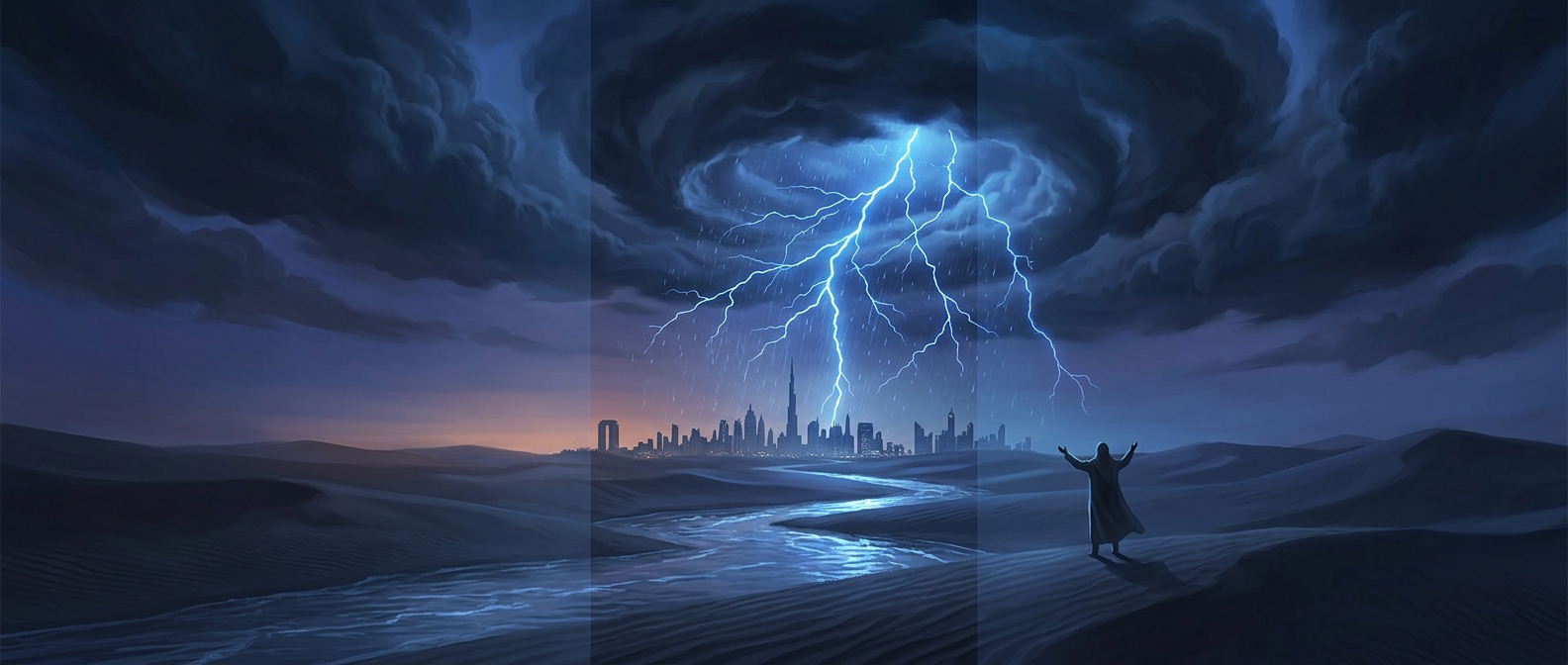
Why Dubai looks to clouds already in the sky
In Dubai’s dry climate, cloud seeding is an attempt to get more rain from certain clouds—not to summon rain from a clear sky. The process depends on clouds that already contain moisture and have conditions in which droplets can grow. Without a suitable cloud, there is little for seeding to influence.
How an electric charge could help
In some experiments, drones enter a cloud and release electrical charges. The idea is that charged droplets may interact in ways that encourage them to meet and merge. Larger droplets are more likely to fall than tiny ones, which can remain suspended in the air. If enough droplets grow, they may descend as rain.
That chain is conditional: a charge does not simply switch rainfall on. Cloud structure, moisture, and air movement all affect whether droplets grow and reach the ground. Seeding is therefore an effort to influence a natural process, not a reliable way to choose when and where it rains.
A local intervention, not a weather machine
For visitors, the striking part is that this technology works with passing weather rather than replacing it. A drone can be sent toward a promising cloud, but the cloud itself supplies the water and the atmospheric conditions that determine what happens next. In a city where rain is relatively uncommon, the effort is aimed at nudging a brief opportunity in the sky—not manufacturing a storm on demand.