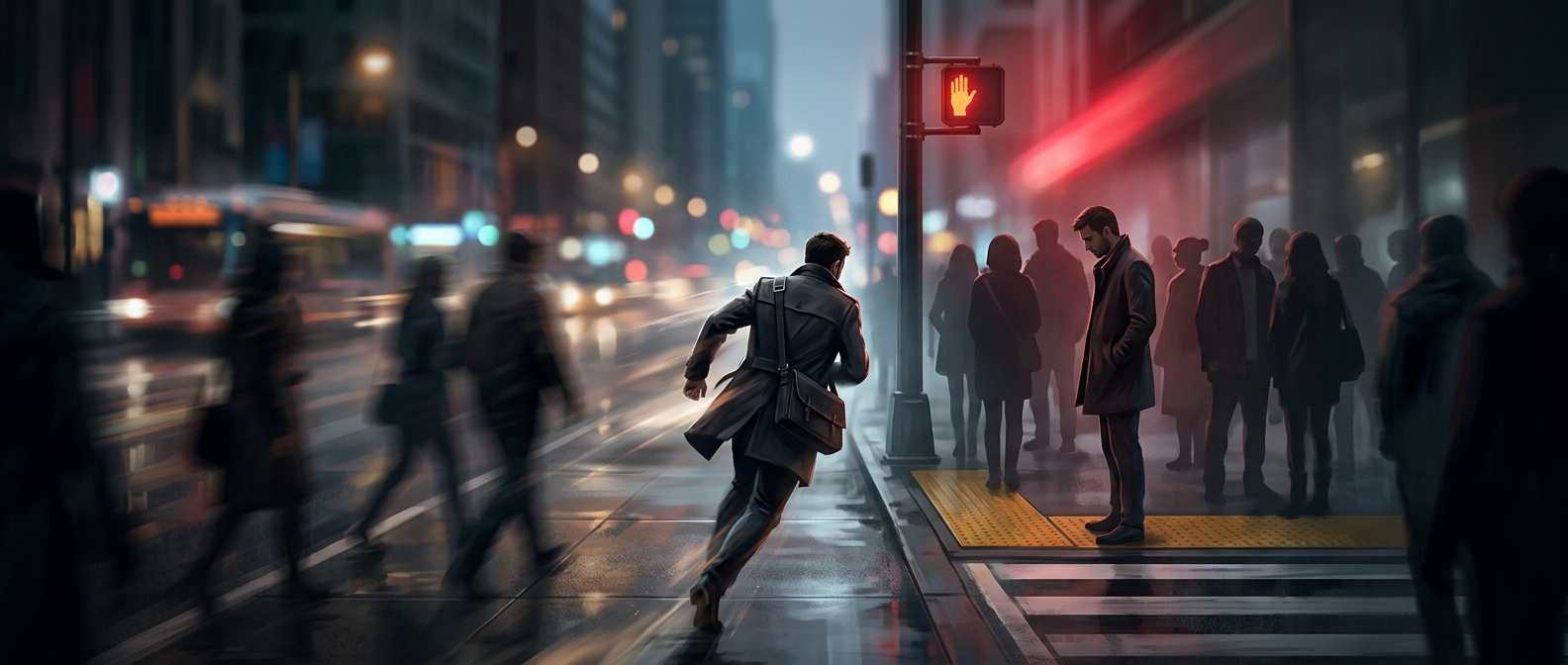
Why a short city trip can favor the person on foot
A car’s speed advantage matters only while it is moving. On a short urban route, intersections can consume much of the travel time: a driver who reaches a red light must stop, wait for the signal cycle, then accelerate again. A pedestrian walking beside the road may reach the same crossing during the wait and continue as soon as the walk signal allows.
The difference is a matter of average speed, not top speed. Average speed includes every pause. A car can move much faster than a person between intersections and still arrive later if it spends enough time stopped.
Why the result changes from block to block
Signals are timed to manage conflicting streams of traffic, not to keep one particular car moving. A driver who catches several red lights can lose time at each one; someone who happens to catch green lights may pass through with little delay. The outcome also depends on the route: a pedestrian may take a direct sidewalk path while a driver must follow one-way streets, wait behind other vehicles, or slow for turns and congestion.
That does not make walking reliably faster. Longer distances give the car more opportunity to make up time, while a crowded sidewalk, a slow crossing phase, or a car arriving at a green light can reverse the result. The comparison is most striking over a few city blocks, where a single signal can represent a large share of the whole trip.
A red light temporarily erases the car’s speed advantage. In stop-and-go traffic, the fastest way along a block may be the one that never has to stop at the intersection.