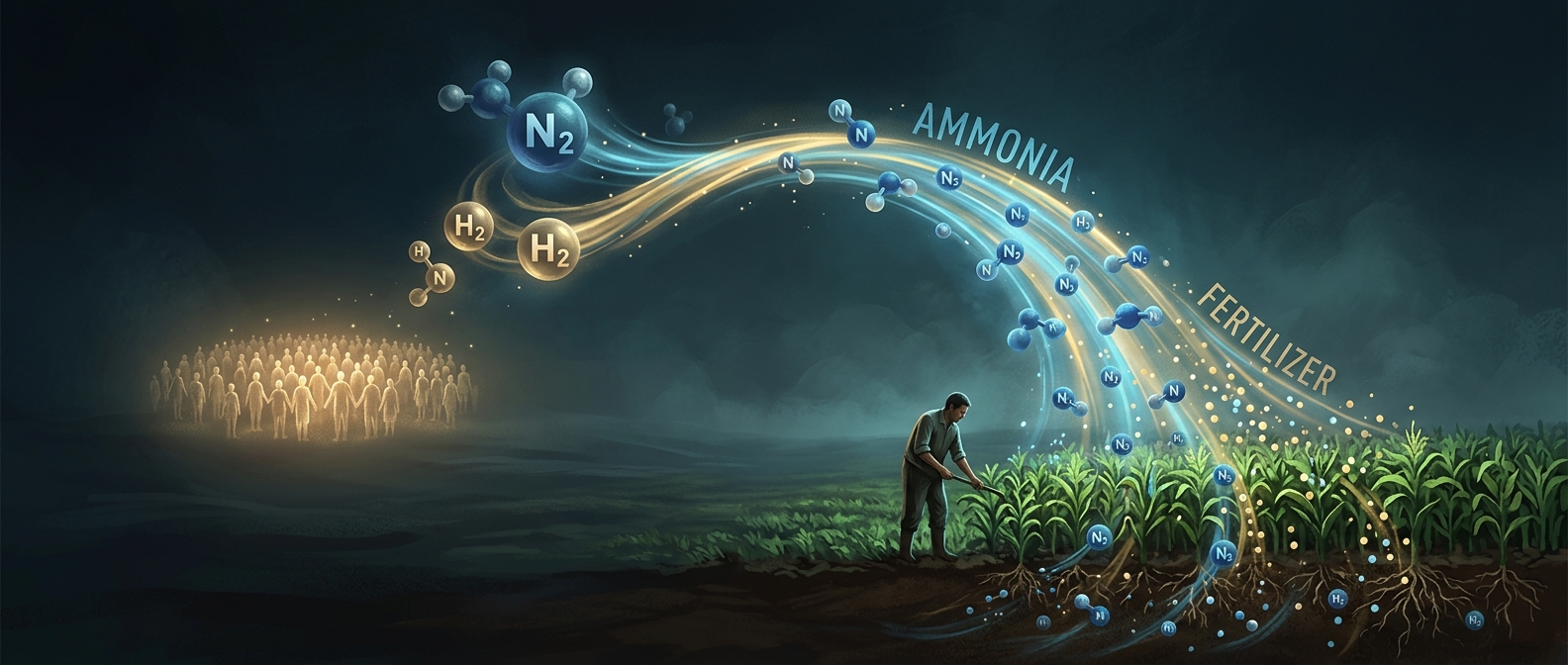
How nitrogen becomes fertilizer
Air is mostly nitrogen gas, but its nitrogen atoms are tightly joined in pairs. Most crops cannot use that gas directly. They need nitrogen in compounds their roots can absorb, such as ammonia-derived fertilizers.
The Haber–Bosch process makes ammonia by combining nitrogen from the air with hydrogen, usually obtained from natural gas. Under high pressure and heat, a catalyst—a material that speeds a reaction without being consumed—helps the gases form ammonia. The process does not create nitrogen; it makes the abundant nitrogen in air usable for agriculture.
The energy and economic bargain
Those demanding conditions take substantial energy, and natural gas often supplies both the hydrogen and the heat. That makes fertilizer costs sensitive to fuel prices and means production can carry a significant climate footprint. Manufacturers therefore face a tradeoff: reliable, concentrated nitrogen fertilizer supports high crop yields, but producing it depends on energy-intensive industrial plants.
Farmers gain a powerful way to replenish nitrogen that crops remove from fields. But fertilizer is not a simple guarantee of higher harvests: its value depends on applying the right amount at the right time, alongside suitable soil, water, and other nutrients. Nitrogen that crops do not take up can wash into waterways or escape into the air, turning an input purchased to grow food into pollution.
A global food-system hinge
Synthetic nitrogen fertilizer helped make modern high-yield farming possible, which is why its production is often described as supporting food for roughly half the world. That dependence connects fields to factories and energy markets: a disruption or sharp rise in fertilizer costs can reach farmers’ budgets and, in turn, food prices. The striking part is that a gas almost every breath passes through becomes a crop nutrient only after industry spends energy to unlock it.