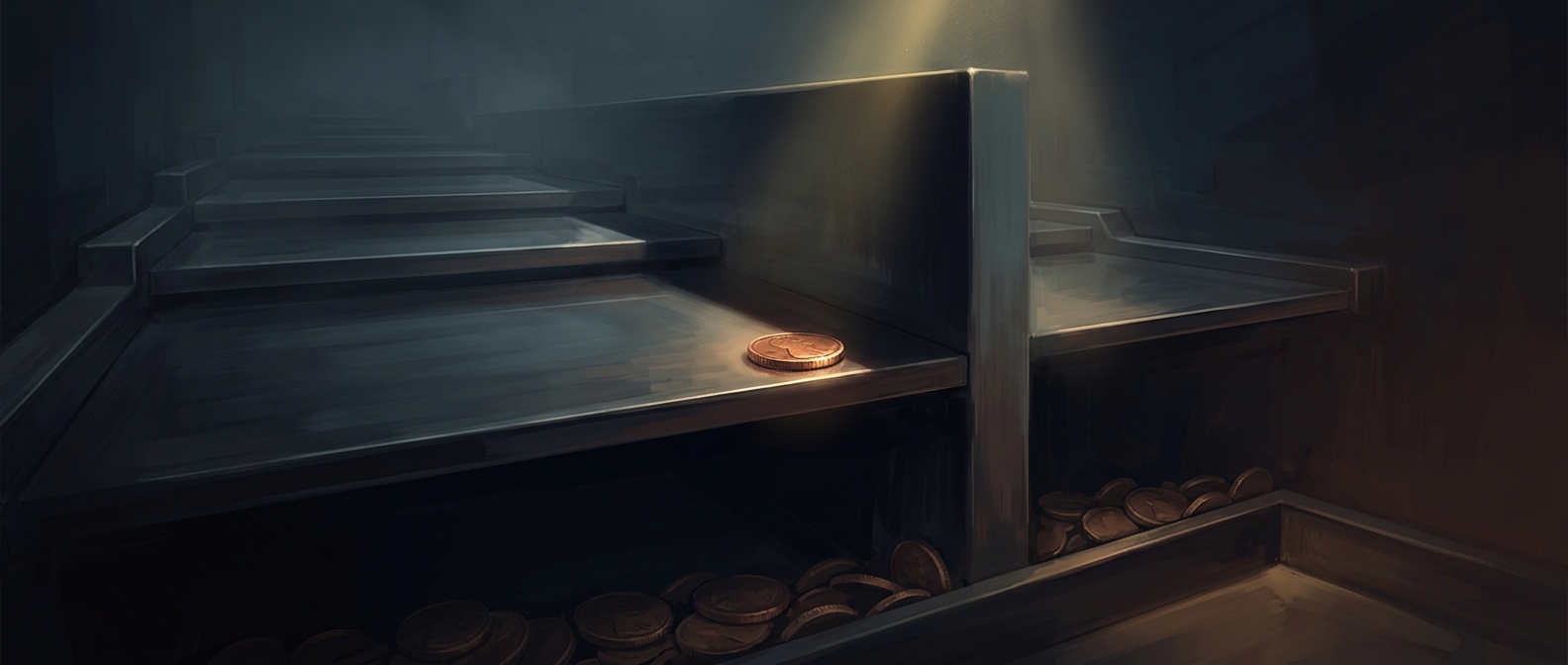
The shelf turns a pile into a slow-motion avalanche
Inside a coin pusher, a motor repeatedly moves a broad shelf forward and backward. Coins on that shelf are packed close together, so each forward stroke passes pressure through the pile: rear coins press into the ones ahead, and the front rows shift toward the drop. The motion is not a single shove. Each cycle advances some coins a little, while others barely move.
That uneven movement matters. A coin can tilt onto its edge, wedge against its neighbors, or land partly supported by another coin. These unstable arrangements let a pile creep forward without immediately collapsing. When enough support finally shifts, several coins may tumble at once.
Why the edge is a narrow escape route
The shelf’s raised rim acts as a final catch. A coin reaching the edge has to rise over it rather than simply continue across a flat surface. Coins pressing from behind can help it climb, but the rim also catches coins that are only partly over the boundary. The result is a pile that can look ready to fall while remaining perched through several strokes.
This makes the machine’s reward feel close and visible: players can watch coins accumulate at the lip and imagine one more push will release them. But the outcome depends on how the coins are stacked and how each cycle redistributes pressure—not just on the coin a player drops. The most dramatic drops often happen when a small shift changes which coins are supporting the front row.