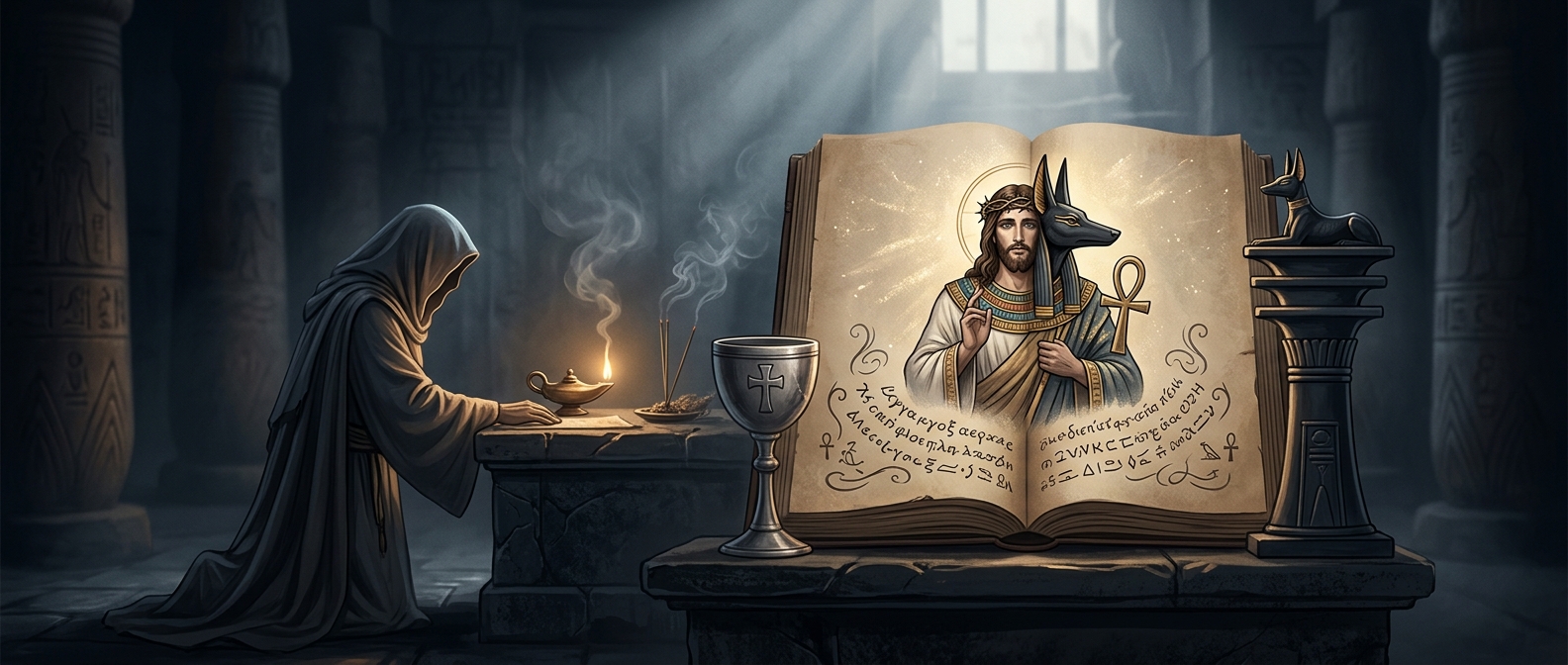
A spell could draw on more than one sacred world
The Greek Magical Papyri are a collection of ritual texts preserved on papyrus in Egypt. Their spells reflect a place where Greek, Egyptian, Jewish, and Christian traditions could meet in everyday life. A practitioner might call on Jesus, the jackal-headed Egyptian god Anubis, and Aphrodite—the Greek goddess of love—in a single ritual, without trying to reconcile their religious teachings.
That combination makes more sense if a spell is understood as a practical appeal, not a statement of belief. Its author wanted a result: protection, healing, attraction, or success. Names associated with divine power could be gathered into the same invocation because each might lend force or authority to the request.
Sacred names as ritual tools
A spell might address divine figures, recite special words, and prescribe actions or materials. Some texts also use strings of unusual syllables, often called magical names—words treated as potent in the ritual even when their meaning was unclear. The sequence itself mattered: speaking names and performing actions was part of how the practitioner sought to make the spell work.
The papyri therefore show religious boundaries operating differently in ritual than in formal doctrine. A name could be useful because it carried power across a community’s many traditions, not because the practitioner considered every figure identical. In one spell, the same voice could reach from an Egyptian god to a Christian holy figure and a Greek goddess—treating a crowded religious landscape as a storehouse of sacred authority.