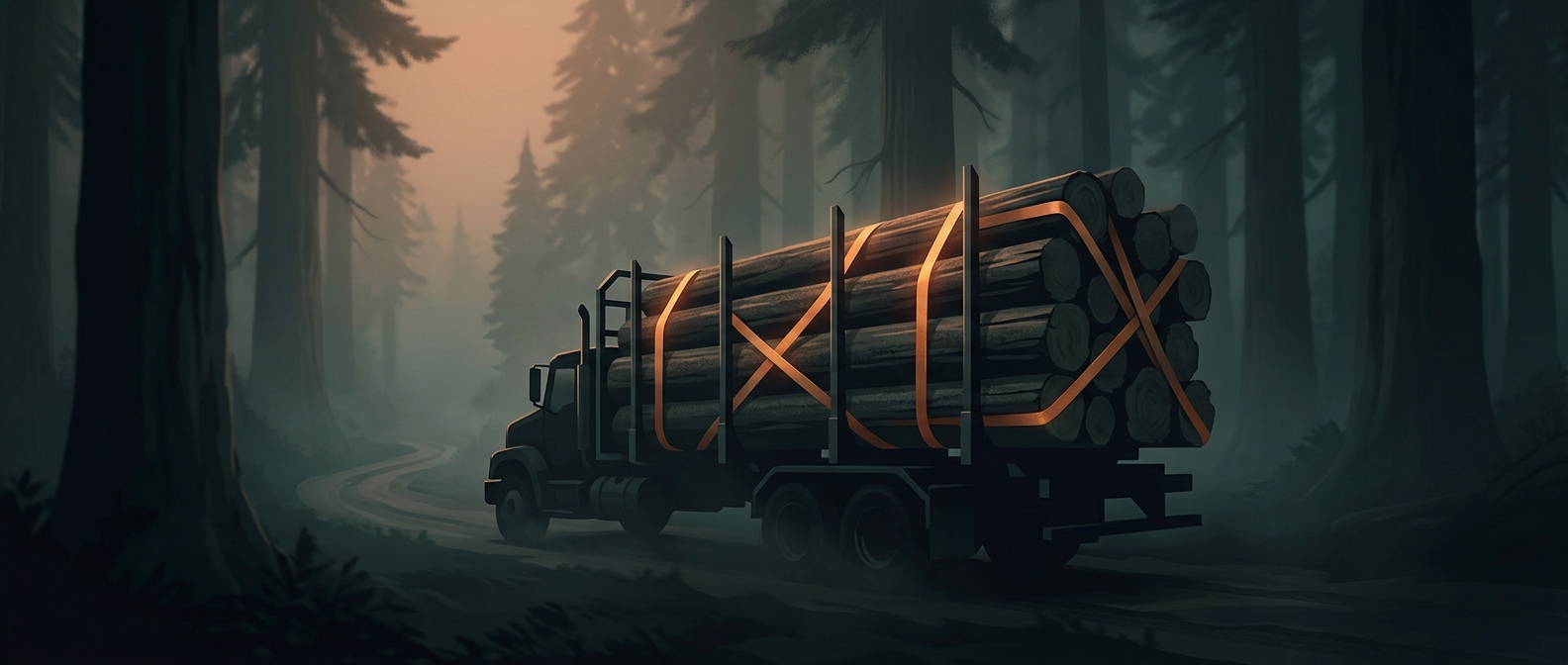
Why a Logging Truck Is Built Around the Load
A conventional cargo bed is designed to support a broad, relatively stable object. Logs are the opposite: they are long, round, and often vary in diameter. Stack them on a flat platform and the lower trunks can roll, while the ends may extend far beyond the truck. A logging rig instead uses widely spaced supports, leaving most of the space beneath the timber open.
Stakes and Chains Do Different Jobs
The upright stakes at the sides of each support act as physical barriers. They help stop the outer logs from sliding sideways, but they cannot hold an irregular stack together on their own. Chains wrap over the load and are tightened to press the logs into a more compact bundle. That pressure helps limit shifting and bouncing as the truck brakes, turns, or crosses uneven pavement.
The combination matters because round timber does not interlock like a load of squared lumber. Contact between trunks can help keep them in place, but gaps and differences in size leave room for movement. The stakes contain the edges; the chains restrain the bundle from above.
The Tradeoff of an Open Frame
A sparse frame saves weight and makes it easier to load long, bulky timber without building a solid-sided container around it. But it also means securement has to do the work that a box-shaped body might do for other cargo. The truck’s structure supports the logs at intervals, while the restraints keep the stack behaving as one load. That is the practical trick: instead of enclosing timber, the rig creates a portable boundary around it.