Why a longboard needs more room to turn
A skateboard does not steer with a handlebar. When a rider leans, pressure twists the trucks—the pivoting assemblies that hold the wheels—so the front and rear wheels angle slightly in opposite directions. That angle guides the board into a curve.
With more distance between its trucks, a longboard traces a broader arc for a similar amount of wheel steering. In simple terms, the wheels have farther to travel along the board, so a small steering angle changes its direction more gradually. A short board can redirect itself over less distance, which is why it feels quicker in a tight corner.
The speed tradeoff
That gradual response is useful when the board is moving fast. A sudden, small shift of weight is less likely to produce an abrupt change of direction, giving the rider a calmer platform for carving—that is, making linked turns by leaning from side to side. The longer wheelbase also spreads the rider’s support over more length, which can make the board feel less twitchy.
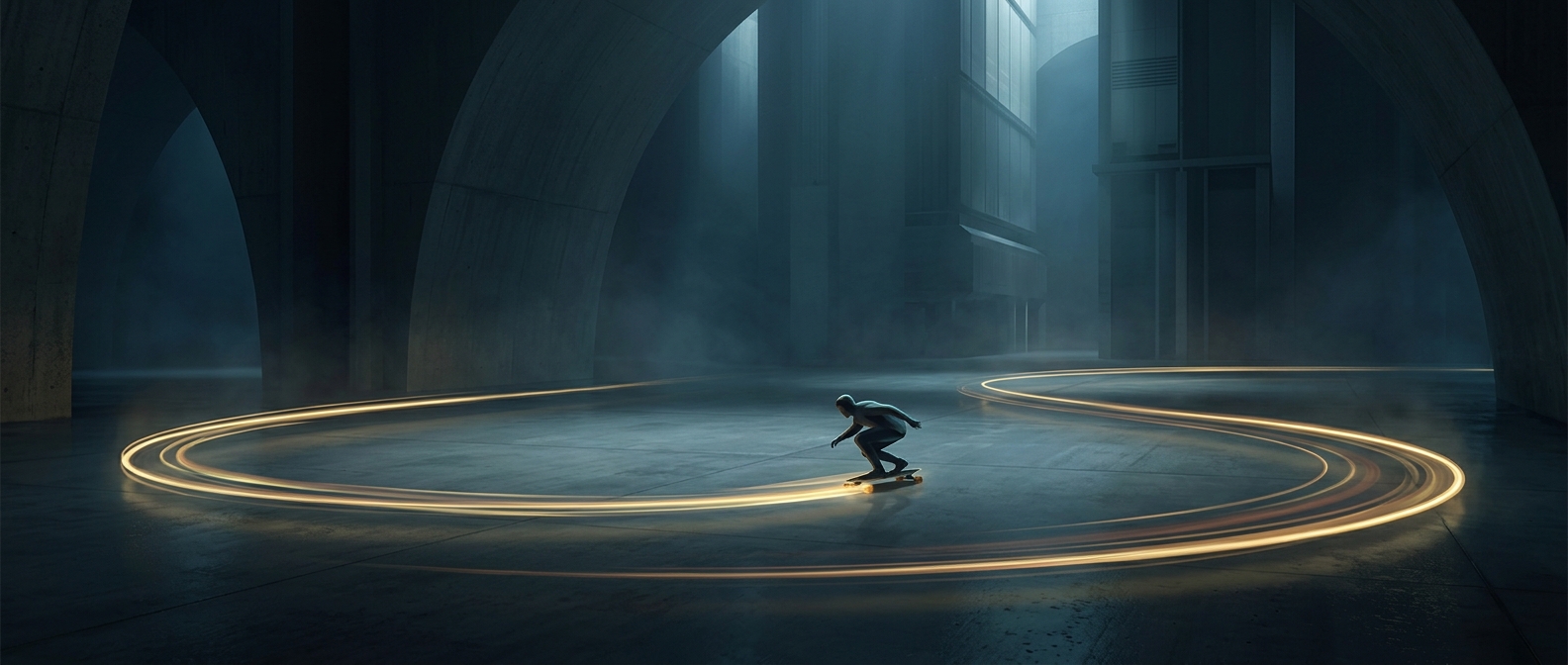
The tradeoff shows up in confined spaces: a longboard may need a wider path to turn around, while a short skateboard can pivot through a tighter space. Turning radius is not set by length alone; truck design, wheel angle, and how far the rider leans all matter. But the basic compromise remains: a board tuned to respond gradually at speed asks for more room when the route bends sharply.