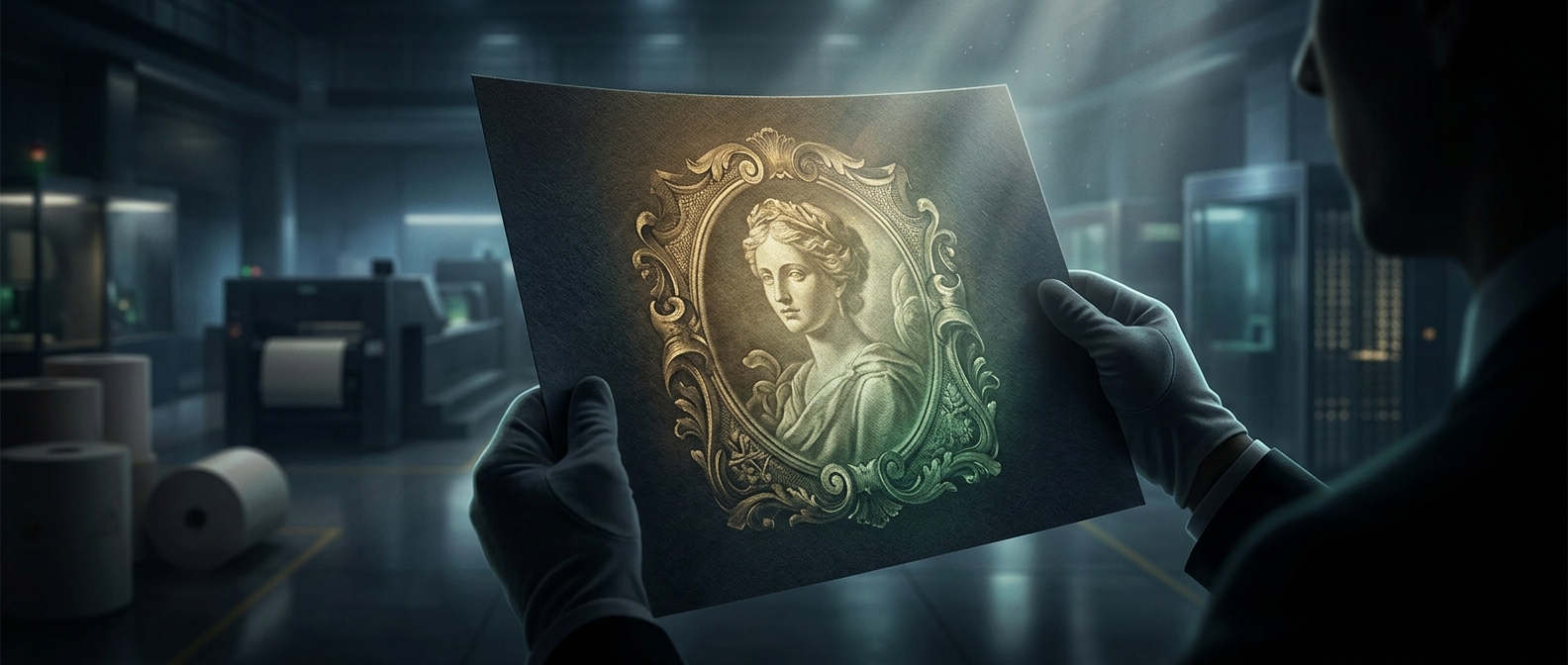
Why a Banknote’s Watermark Appears in the Light
A watermark is formed while banknote paper is still being made. As the damp sheet takes shape, a patterned device presses some areas more firmly than others. This shifts fibers aside and leaves parts of the finished paper thinner or thicker, creating an image within the sheet rather than a layer of ink on its surface.
Thickness Turns Into Contrast
Hold the note up to a light, and the difference becomes visible. Thinner areas let more light through and look brighter; thicker areas block more and look darker. Together, those variations make the watermark’s shapes and tones. The image is easiest to see against a bright background because light passing through the paper reveals changes that are subtle when viewed straight on.
A Feature That Is Harder to Copy
Because the image depends on the paper’s structure, reproducing it accurately means matching the way the sheet was formed—not simply printing a convincing picture. That makes the watermark one of the security features people can check directly: turn the note toward a light source and look for the design within the paper. Its changing brightness is the visible trace of how the paper itself was made.