How a Flame Makes Smoke Particles
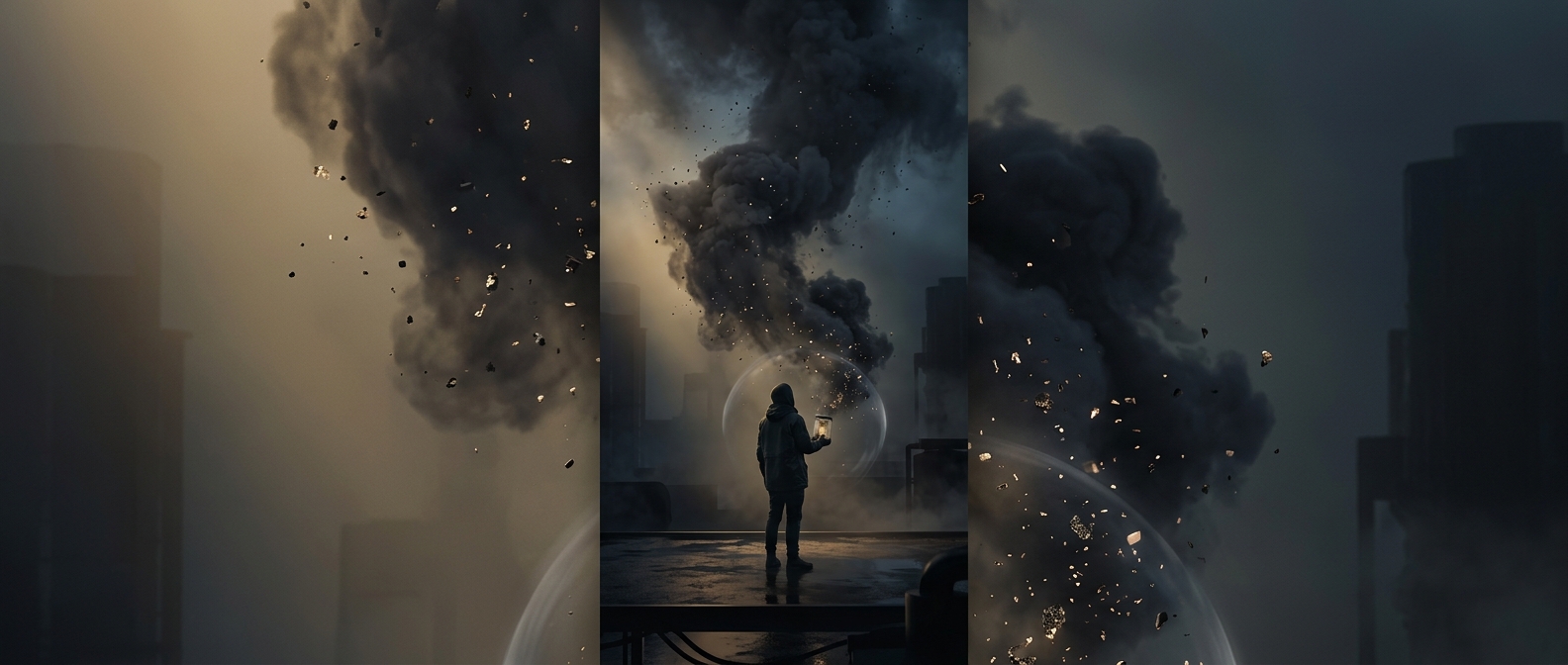
A fire does not turn all its fuel neatly into invisible gas. As heat breaks wood, oil, or other material apart, it releases vapors. Near the flame, some of those vapors burn; others cool before they can finish reacting. Carbon-rich leftovers can clump into soot, while minerals and bits of ash may be carried upward. Water and other vapors can also condense into tiny liquid droplets as the plume cools.
The result is a shifting mixture, not one uniform substance. Its particles differ in size and composition, depending on the fuel, the heat, and how much oxygen reaches the fire.
Why Smoke Looks Different from Fire to Fire
Light becomes visible in a plume when particles redirect some of it toward an observer. The color depends partly on which wavelengths the particles scatter or absorb, and partly on the light behind them. Dark, carbon-rich smoke absorbs much of the light passing through it; pale smoke often contains droplets or particles that scatter light more broadly. Neither color, by itself, identifies every substance in the smoke.
Air currents then carry the particles away from the hottest part of the fire. As the plume cools and mixes with surrounding air, its droplets may evaporate, particles may combine, and the smoke may spread until it is too diluted to see. But invisibility does not mean every particle has vanished: some can remain suspended and travel into places the plume never visibly reaches.