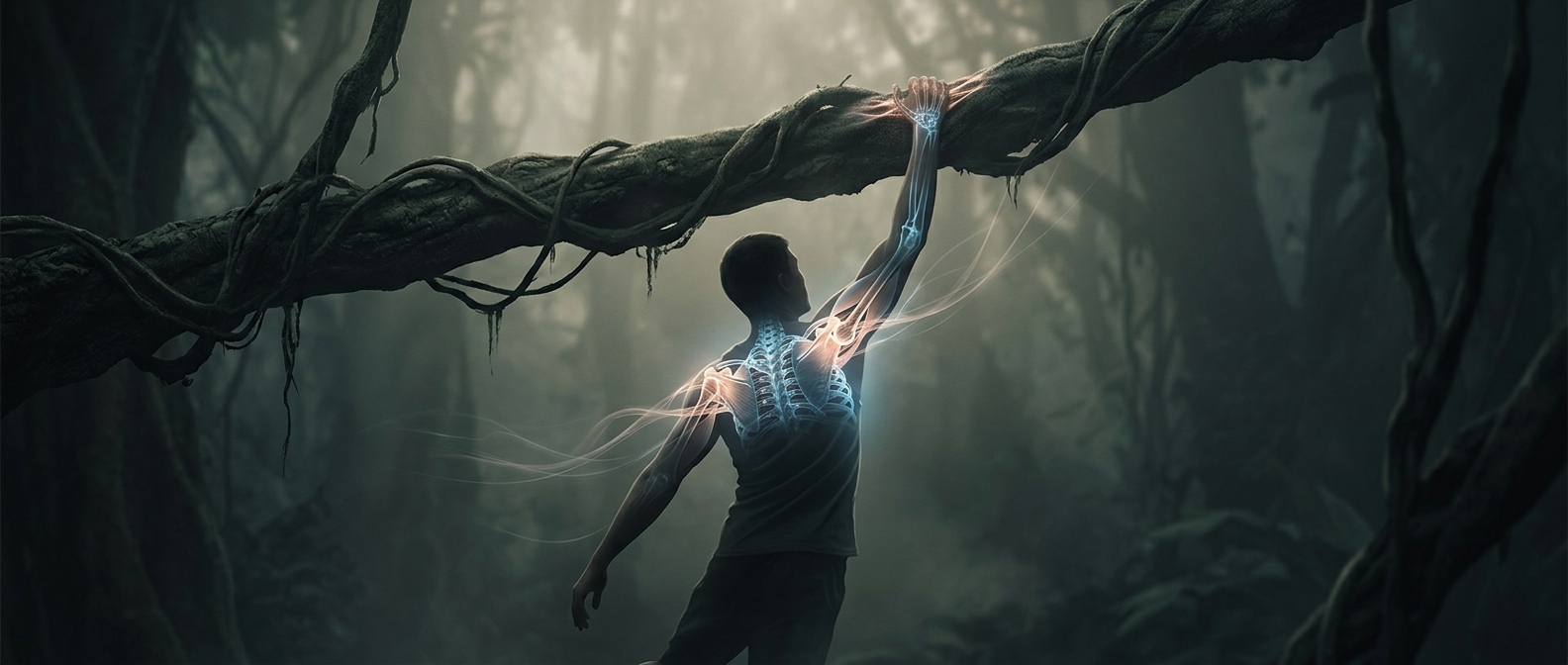
Branch-to-branch travel demands a specialized body
Swinging from branch to branch—called brachiation—is not simply a matter of being able to grab a limb. Each swing puts much of an animal’s weight on one arm while its body moves forward, then asks the other arm to catch and redirect that momentum. Long arms extend the reach and help keep the body clear of the trunk; strong shoulders absorb the load and power the next swing.
Hands and feet matter, too. A secure grip must hold while the body shifts underneath it. Many tree-dwelling primates can use their feet as additional grasping points, creating a four-limbed safety net as they move. Humans’ feet are built instead for bearing weight on the ground, and our shorter arms limit how far we can reach between supports.
A ground-walking body makes different tradeoffs
Human shoulders can move through a wide range of motion, but that flexibility alone does not make them suited to repeated, high-force swings. Our bodies are relatively heavy for the reach our arms provide, and our shoulder and hand anatomy is not specialized for catching the full force of a fast-moving body over and over. A human might hang from a branch or climb with effort; moving quickly through a canopy would demand strength, reach and grip that ordinary human anatomy does not supply efficiently.
Evolution favors workable tradeoffs, not one body plan that excels everywhere. For humans, upright walking makes it possible to travel across the ground with hands free for carrying and handling objects. The same proportions that serve that way of moving are a disadvantage when the route has no floor. In a forest canopy, a gap that a swinging specialist can cross in one fluid transfer may be an obstacle a human has to approach by climbing, finding a stable foothold or going around.