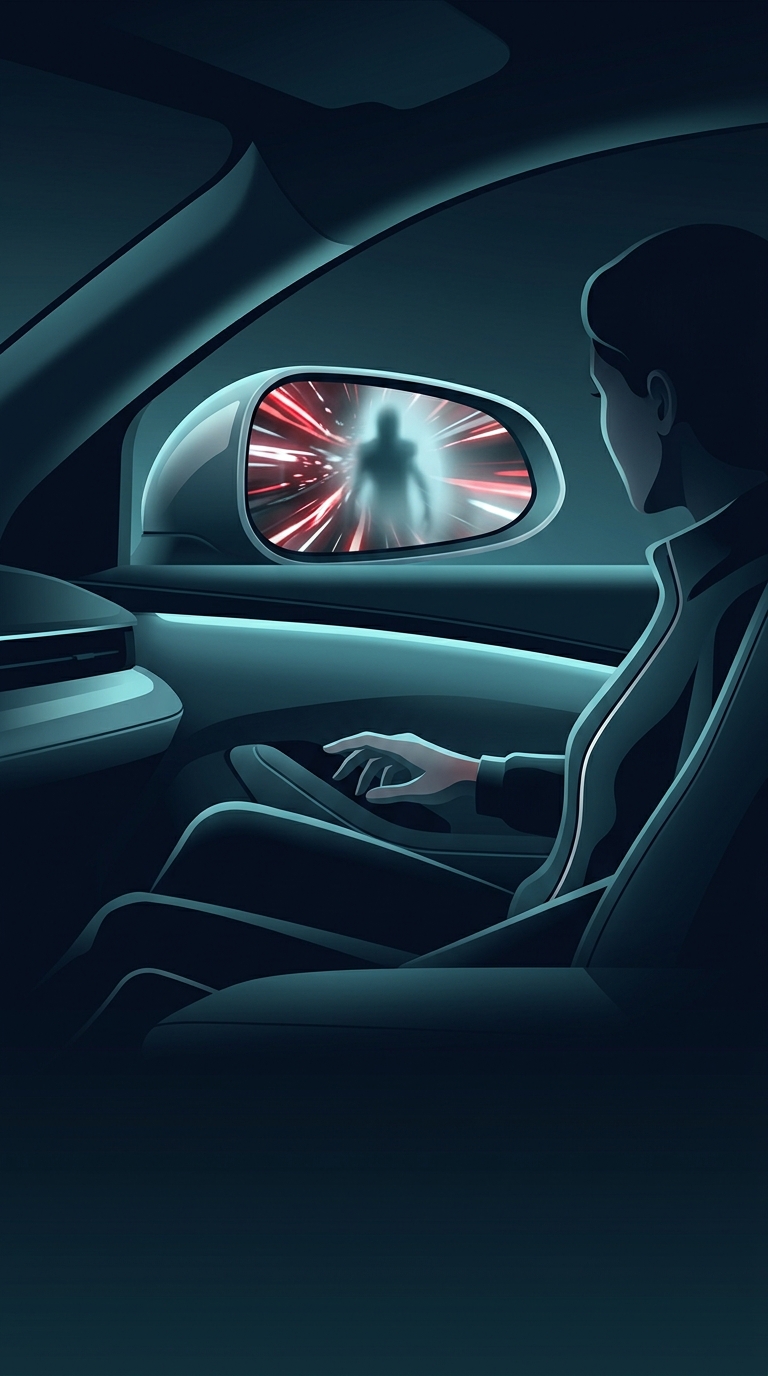
Why the Passenger-Side Mirror Distorts Distance
A passenger-side mirror often curves outward more than the driver-side mirror. That convex shape lets it show a wider slice of the road, including vehicles alongside the car that would otherwise sit in a blind spot. The tradeoff is that it compresses the reflected scene: nearby cars look smaller, and their distance is harder to judge.
A Wider View, With a Cost
A flat mirror reflects light without changing the scene’s apparent scale much, but it covers a narrower area. A convex mirror bends reflected light so the image fits a broader field of view. The farther outward the mirror curves, the more roadway it can reveal—and the more the image’s size and spacing differ from what the driver sees directly.
That difference matters during a lane change. A car that appears small in the mirror may be close enough to overlap the passenger car’s path. The warning is there to counter the instinct to read the reflected image as if it were a flat, life-size view.
How to Read the Warning
The mirror is useful for spotting traffic, but not for judging its distance on its own. Drivers can check the passenger-side mirror, glance over the shoulder when safe, and use the vehicle’s position and motion over successive glances to judge whether another car is closing in. The wider view helps reveal a hidden vehicle; the warning reminds drivers that the image makes that vehicle look farther away than it is.