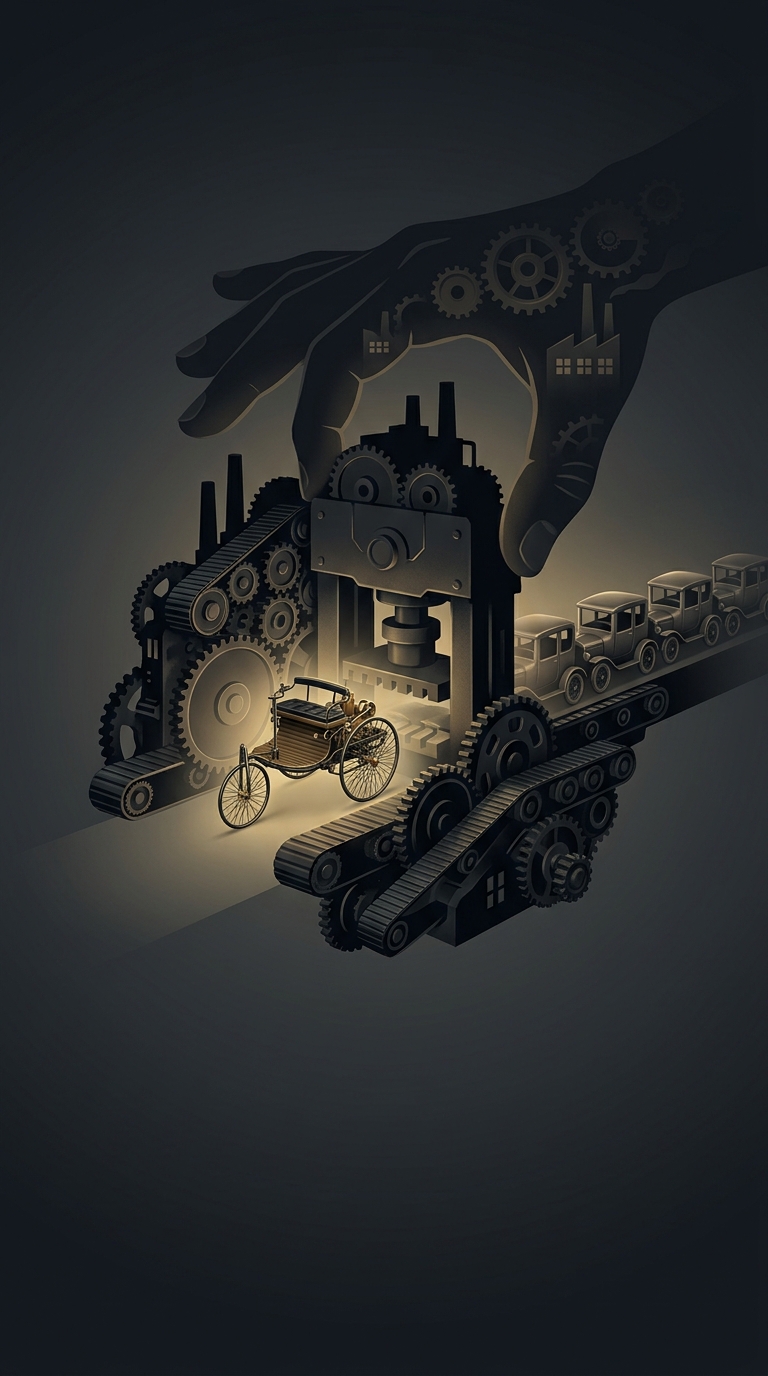
How Ford Made the Assembly Line Move
Ford’s key production change was not simply putting workers in a row. In older shop-floor methods, a team could assemble a vehicle largely in one place, with workers and parts moving around it. Ford’s factories instead brought the work to the car: a chassis—the vehicle’s basic frame—advanced through a sequence of stations, and each worker performed a limited, repeated task as it passed.
That change made the pace and order of production easier to control. Once one step was finished, the chassis moved on to the next, rather than waiting for an entire crew to complete many jobs together. The line could keep several vehicles in progress at once, while workers became skilled at their particular operations.
Why a Moving Chassis Changed the Economics
A moving line depended on more than a conveyor. Parts had to arrive in the right place at the right time, and the work at each station had to be divided so one task did not hold up everything behind it. When those pieces fit together, a factory could turn out cars faster and more consistently.
Higher output helped Ford reduce the cost of making each car, making lower prices possible. The tradeoff was that the production system asked workers to repeat narrow tasks at the line’s pace. A faster factory therefore changed both sides of carmaking: it made automobiles more accessible to buyers, while making many factory jobs more repetitive.
Ford’s breakthrough was the moving sequence itself: instead of treating a car as a project assembled in one spot, the factory treated it as work carried steadily from one operation to the next.