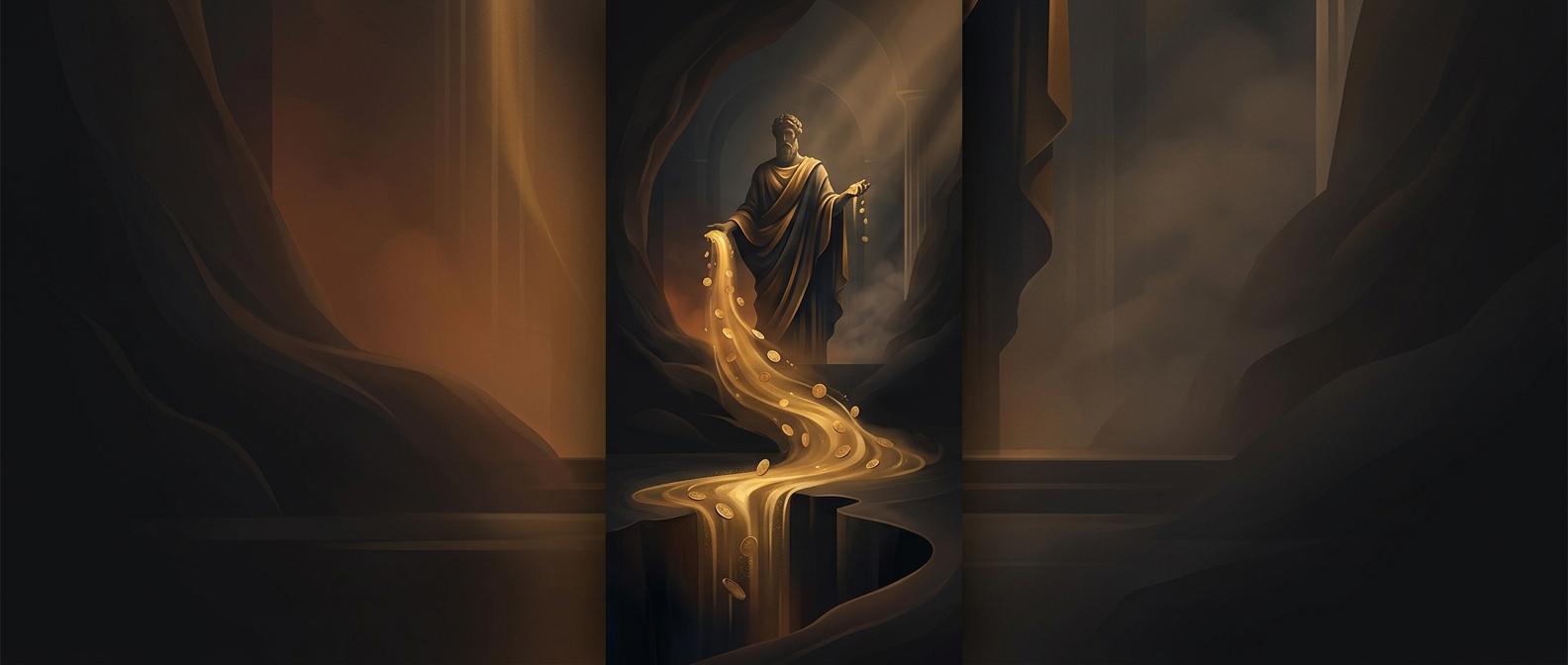
Why Plutus Couldn’t See Who Got Rich
In Greek myth, Plutus personified wealth itself. Artists often showed him as a child, and the poet Aristophanes made his blindness central to a comedy: if the god could see, he could choose whom to enrich. Unable to see, he distributes riches without regard to character or merit.
That image turns a familiar complaint into a divine mechanism. The question is not simply whether someone deserves wealth, but why money so often seems to land elsewhere. Plutus’s blindness makes fortune look arbitrary: goodness does not guarantee prosperity, and prosperity does not prove goodness.
A Comedy About Changing the Rules
In Aristophanes’ play Plutus, a poor but honest Athenian encounters the blind god and tries to restore his sight. The proposed cure carries a tempting promise: wealth could finally go to decent people instead of being scattered indiscriminately. But the fantasy immediately raises a harder problem—who gets to decide who counts as decent?
The myth’s force lies in that tension. If riches were deliberately assigned, the distributor would need a standard of deservingness, and someone would have to enforce it. Blindness avoids that judgment, but leaves people exposed to luck and unequal outcomes. Plutus makes wealth’s apparent randomness a feature of the story, not proof that the distribution is fair.