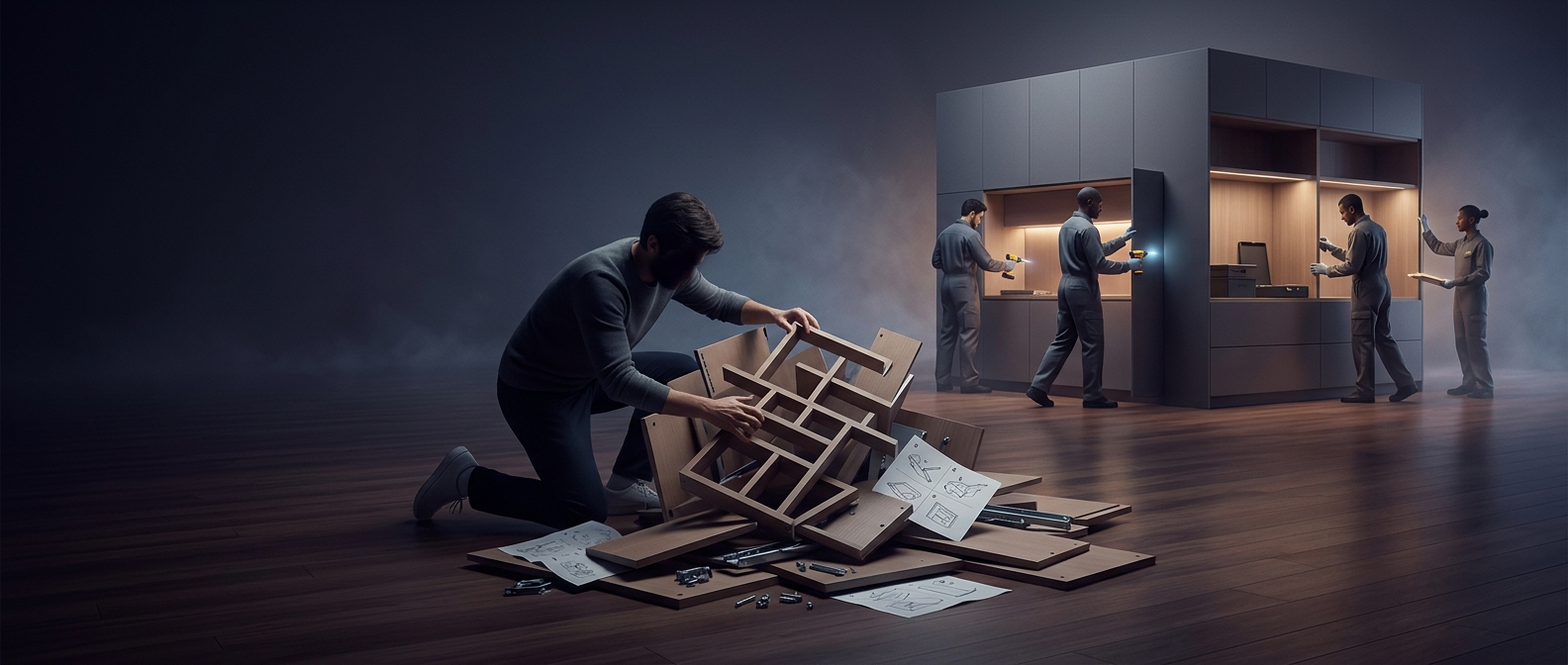
The labor hidden inside a flat box
Flat-pack furniture saves space before it reaches a home: disassembled pieces can be stacked and transported more compactly than finished furniture. But the product still has to be assembled somewhere. When the buyer does it, the work is not free; its cost is simply paid in time, attention, and the risk of having to undo a mistake.
That tradeoff is easy to miss at purchase. The price tag is visible, while the hours needed to sort parts, identify hardware, and follow the build sequence are not. Instructions try to keep that process usable across languages, often relying on diagrams instead of detailed prose. The result has to communicate three-dimensional steps on a flat page, sometimes with parts that look nearly alike or can be turned in several directions. A small ambiguity can send an assembler back several steps.
Paying to make the tradeoff go away
Assembly services turn that hidden labor into an explicit expense. A customer is not only paying for the physical work, but also for someone else to manage the sequence and absorb the frustration of deciphering it. For the assembler, the appeal is that familiarity can make a confusing task more predictable; for the customer, the calculation is whether the saved time and effort are worth the fee.
This is why a low-cost item can still feel expensive to own. Its purchase price covers the object, but not necessarily the effort required to make it usable. The final choice is a small household version of a broader economic tradeoff: spend money to buy back time, or spend time to keep the cash.