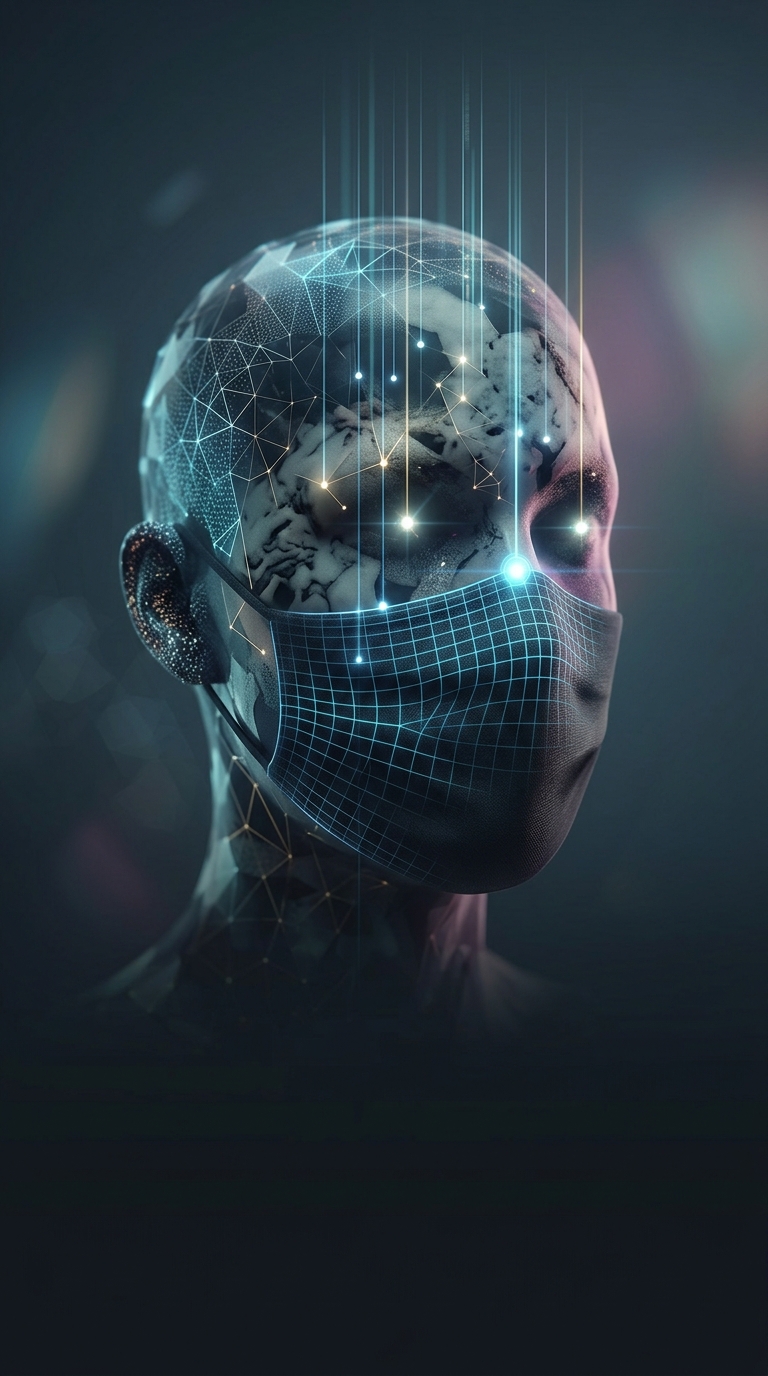
Masked faces changed what the software had to compare
Many facial-recognition systems work by turning a face into a mathematical representation—a set of patterns the software can compare with representations stored in a database. Masks hid much of the lower face, including the mouth and jawline, so systems trained mainly on uncovered faces lost some of their most useful visual information.
The workaround was to make recognition less dependent on the whole face. Developers trained or adjusted models to extract more from the visible region around the eyes, eyebrows, and bridge of the nose, then compare those features against records. Some systems could also identify that a face was masked and apply a matching approach suited to partial faces.
Training made the adjustment possible
A model learns which visual patterns matter by processing many examples. To improve performance on masked faces, developers could add images of people wearing masks to training data, or create training examples by digitally covering faces. This taught the system that a covered mouth was not a new identity—and that the remaining features deserved more weight.
The software did not need to recognize a mask as a special kind of face in every case. The central change was in what it learned to treat as stable evidence when part of the face was missing. Existing facial-analysis methods could be adapted, while new training helped them handle the unfamiliar conditions at scale.
More useful, but with less evidence
A mask leaves fewer distinguishing details, so recognition generally becomes harder. Changes in lighting, head angle, glasses, or image quality can matter more when the software has only the upper face to examine. Systems may therefore produce less certain matches or require a higher-confidence result before identifying someone.
The rapid shift was less a single breakthrough than a focused response: change the examples and features the models rely on, then test them against masked faces. The practical consequence is that a system may still recognize someone through a mask—but it is making that judgment from a narrower slice of the face.