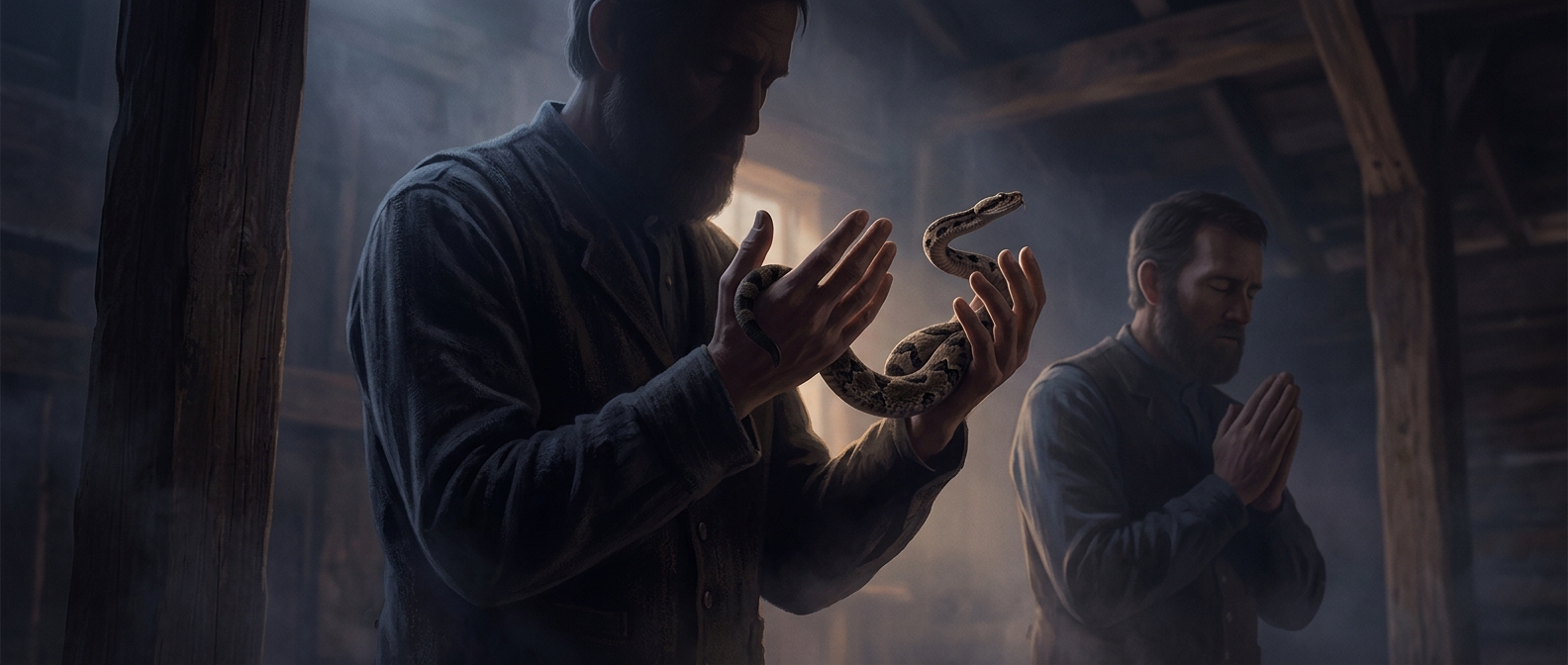
A biblical passage becomes a practiced sign
In some Appalachian congregations, handling snakes is understood not as a stunt but as an act of faith. The practice is tied to a passage near the end of the Gospel of Mark, where Jesus’ followers are said to encounter signs that include taking up serpents. Those who handle snakes read the words as applying to believers in the present, rather than only describing events in the early church.
That interpretation shapes the ritual’s meaning: the danger is real, but facing it is treated as a public expression of trust in God. The practice is not shared by Appalachian Christians generally, or even by all Pentecostal congregations.
Why the risk is part of the ritual
For participants, the point is not that a snake is harmless. The animal’s venom makes the act consequential, and surviving an encounter may be understood within the congregation as evidence of divine protection. This is a religious interpretation, not a guarantee that a bite will be prevented or cured.
The setting also matters. Worshippers gather around the handling as a communal act, with prayer and shared belief giving the danger its religious significance. That can make the practice a powerful marker of commitment and belonging, while also placing the person handling the snake at risk of severe injury or death.
Faith does not remove the biological danger
Venom disrupts the body in ways that depend on the snake and the bite; it can damage tissue, interfere with blood clotting, or affect breathing and circulation. A person may not know immediately how serious a bite is. The central tension is therefore stark: participants may see protection as a matter of faith, but venom still acts through the body, and a bite can be fatal.