How a Slower Spin Made Room for a Long-Playing Record
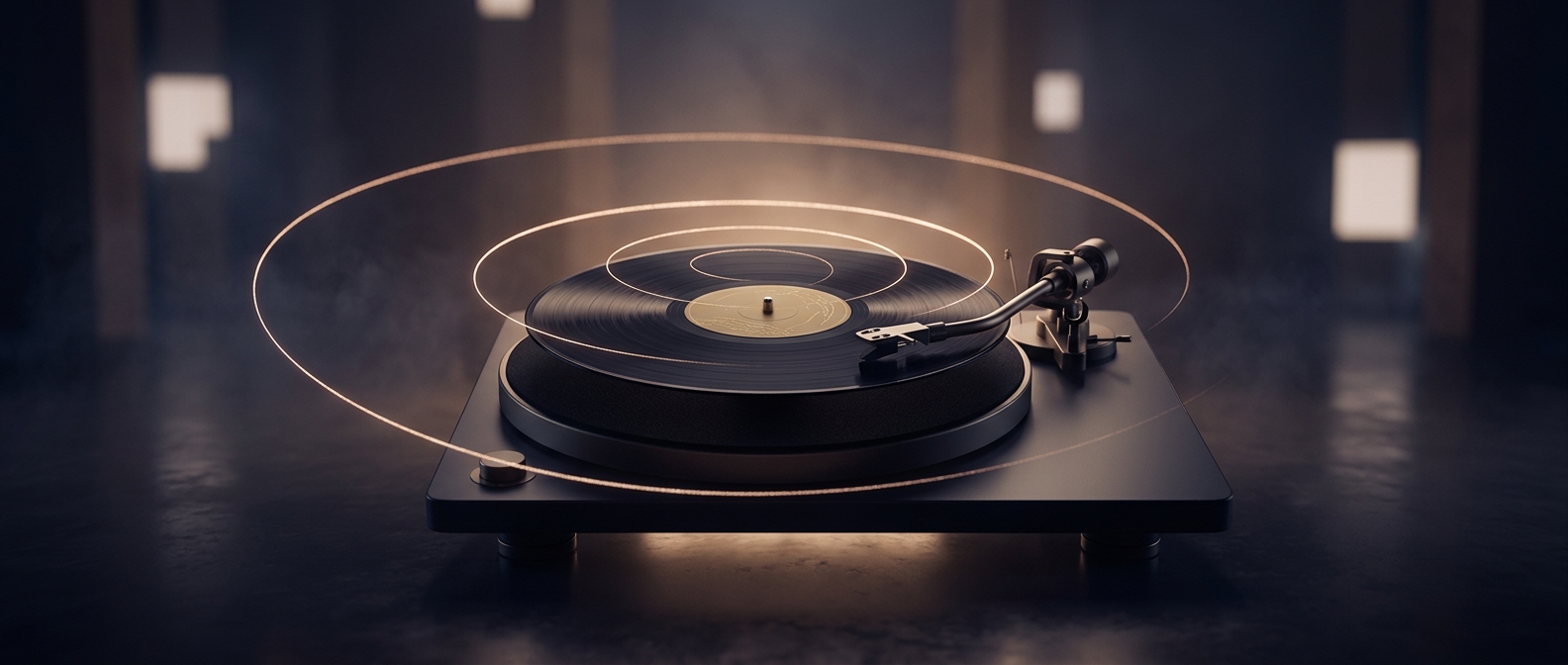
A record stores sound in a groove that winds from its outer edge toward the center. As the turntable spins, a stylus follows the groove’s tiny wiggles; those movements become an electrical signal and, ultimately, sound. Slowing the disc means less groove passes beneath the stylus each second, so the same length of groove can take longer to play.
That extra time mattered because earlier records typically held only a few minutes per side. Columbia’s LP, introduced in 1948, paired the slower rotation with closely spaced grooves, letting a side carry more music without simply making the disc larger.
The Tradeoff Between Time and Sound
A record cannot be slowed indefinitely. The groove must still move fast enough for its fine wiggles to be tracked clearly, especially those corresponding to higher-pitched sounds. The stylus also needs enough room to follow the groove without skipping or distorting the signal.
The LP’s design balanced those demands: more playing time came from fitting more groove onto the disc, while the chosen speed kept playback practical for sound reproduction. Groove spacing and the recording itself also affected how much music could fit, so running at 33⅓ rpm alone did not determine a side’s capacity.
Why the Fraction Stuck
The speed is a rate, not a special feature of the groove: 33⅓ revolutions per minute means the platter completes 33 full turns and one-third of another each minute. Once turntables and records were built around that standard, matching speeds became essential. A mismatch changes both pitch and playback time—the music sounds lower and lasts longer if the disc turns too slowly, and higher and shorter if it turns too fast.
That is why the number still matters on modern turntables: it is the setting that lets the stylus trace the recording at the pace for which the LP was made.