Why a small serving can add up
Granola’s calories are concentrated because much of its weight comes from ingredients that carry substantial energy in little space. Fat supplies more than twice as many calories per gram as carbohydrate or protein, so oil used to toast oats—and nuts or seeds, when included—can raise the total without making the mixture look much bigger. Honey and dried fruit add sweetness in a form that is compact and relatively low in water.
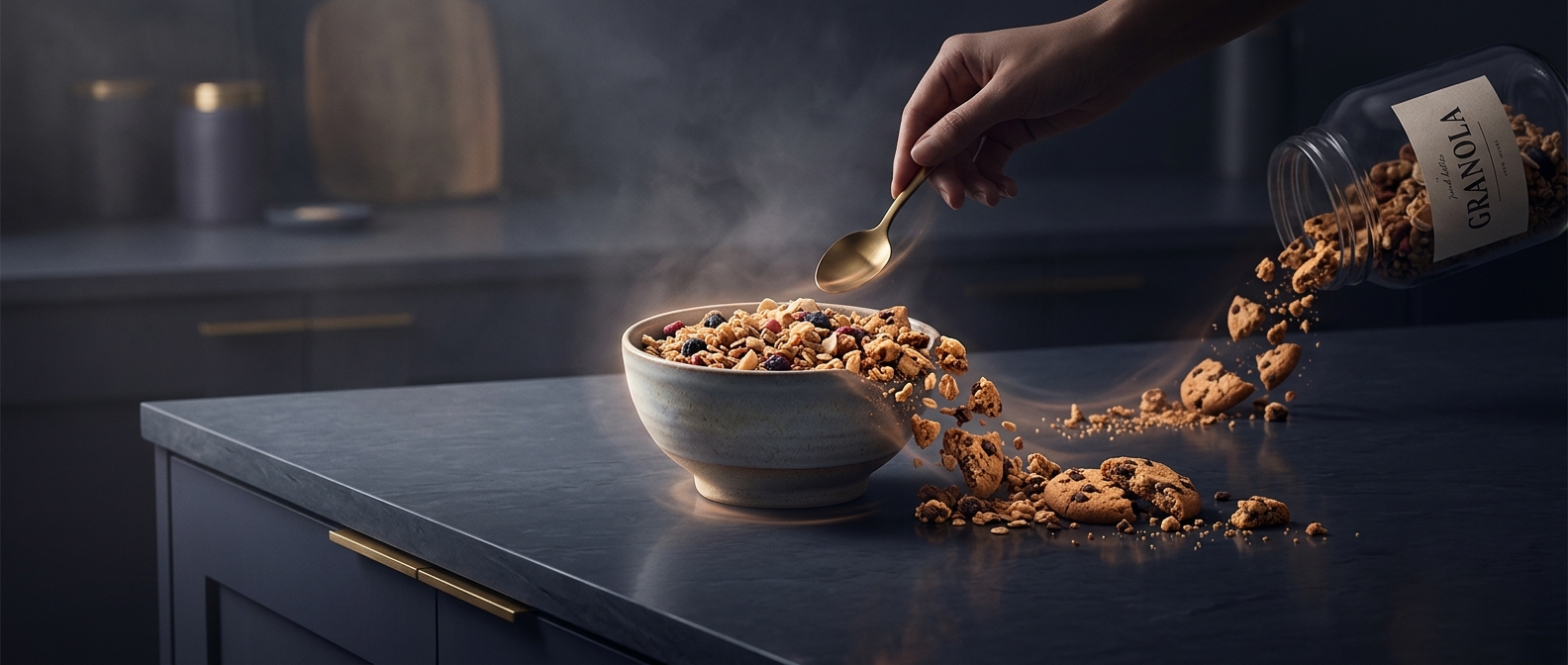
That low water content matters. Foods with more water often take up more room for the same amount of energy; granola is dry, so a bowl can look modest even when it contains a substantial portion. Pouring it loosely can also make serving size hard to judge: pieces leave gaps, and a deep bowl disguises how much has gone in.
Fullness doesn’t follow the bowl’s size
Feeling satisfied depends on more than calories. Volume, water, fiber, protein, and the time spent eating all play a role. Granola may contain fiber, but its dense mix can deliver energy quickly relative to the space it occupies. If it is eaten with yogurt or milk, those additions contribute their own calories and may also change how filling the meal feels.
The practical takeaway is not that granola is a dessert or should be avoided. It is that a bowl’s appearance can be a poor guide to its energy content. Checking the serving size on the package—or measuring a portion once—can reveal how easily a casual pour turns a topping-sized amount into a full bowl.