How a Split Stick Became an Accounting Record
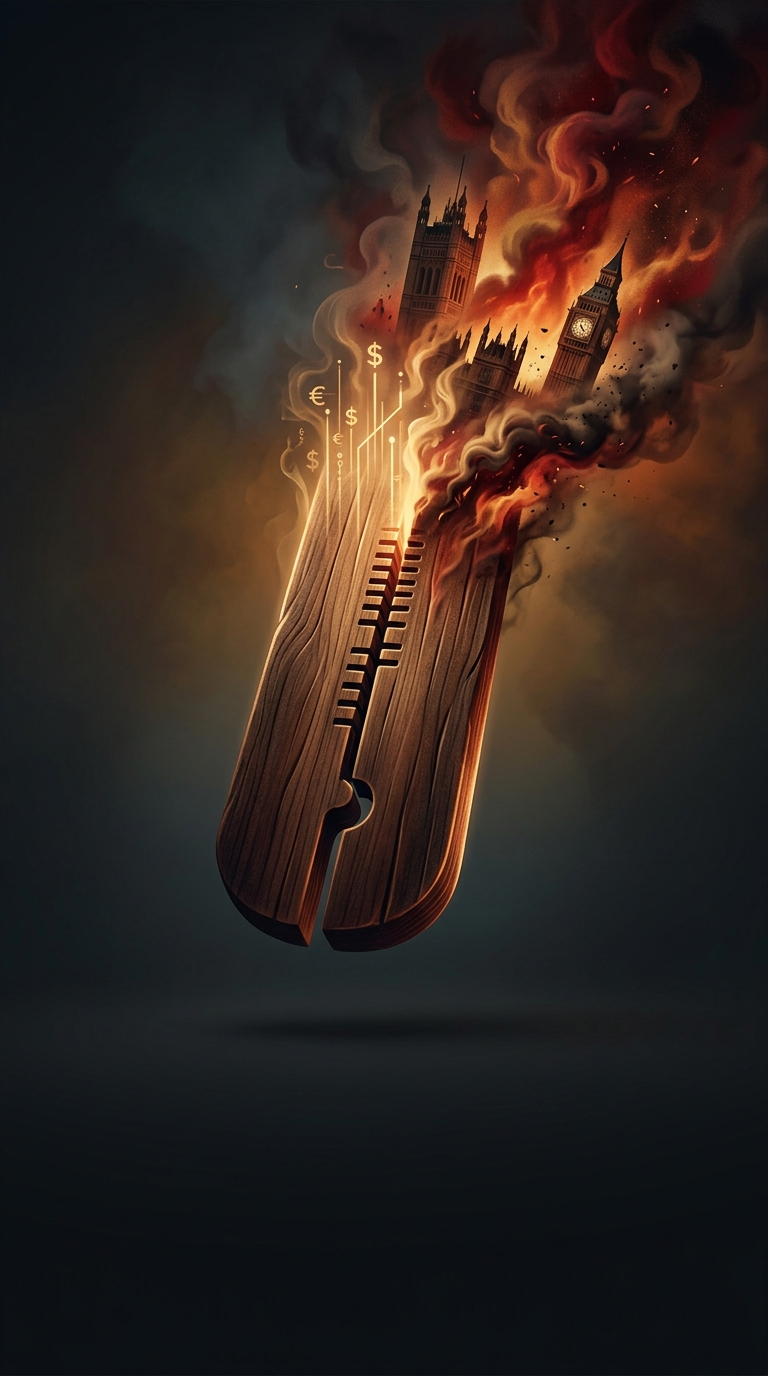
Before paper ledgers became routine, England’s Exchequer—the royal office that managed government money—used wooden tally sticks to record payments and debts. A clerk cut notches into a stick to mark an amount, then split it lengthwise. The two parties kept opposite halves. When an account was checked, the pieces could be fitted together: the notches had to align, and the wood’s natural grain continued across the join.
That made the tally more than a written claim. A forged or altered half was harder to pass off as its counterpart, because the physical match offered a check independent of anyone’s memory. The system turned a simple piece of wood into a receipt that could be carried, stored, and later verified.
When an Old Record System Became Fuel
Over time, newer methods made the accumulated sticks obsolete. But records kept for future reference did not disappear when their accounting purpose did. By 1834, a large stockpile remained at the Palace of Westminster. Workers burned the unwanted tallies in furnaces, and the fire spread through the building, destroying much of the old Palace of Westminster.
The chain of events was strikingly practical: a system built to make public accounts verifiable left behind a physical archive, and disposing of that archive helped set Parliament’s home ablaze. The sticks had outlasted the bookkeeping they served—and became a hazard precisely because they had been kept.