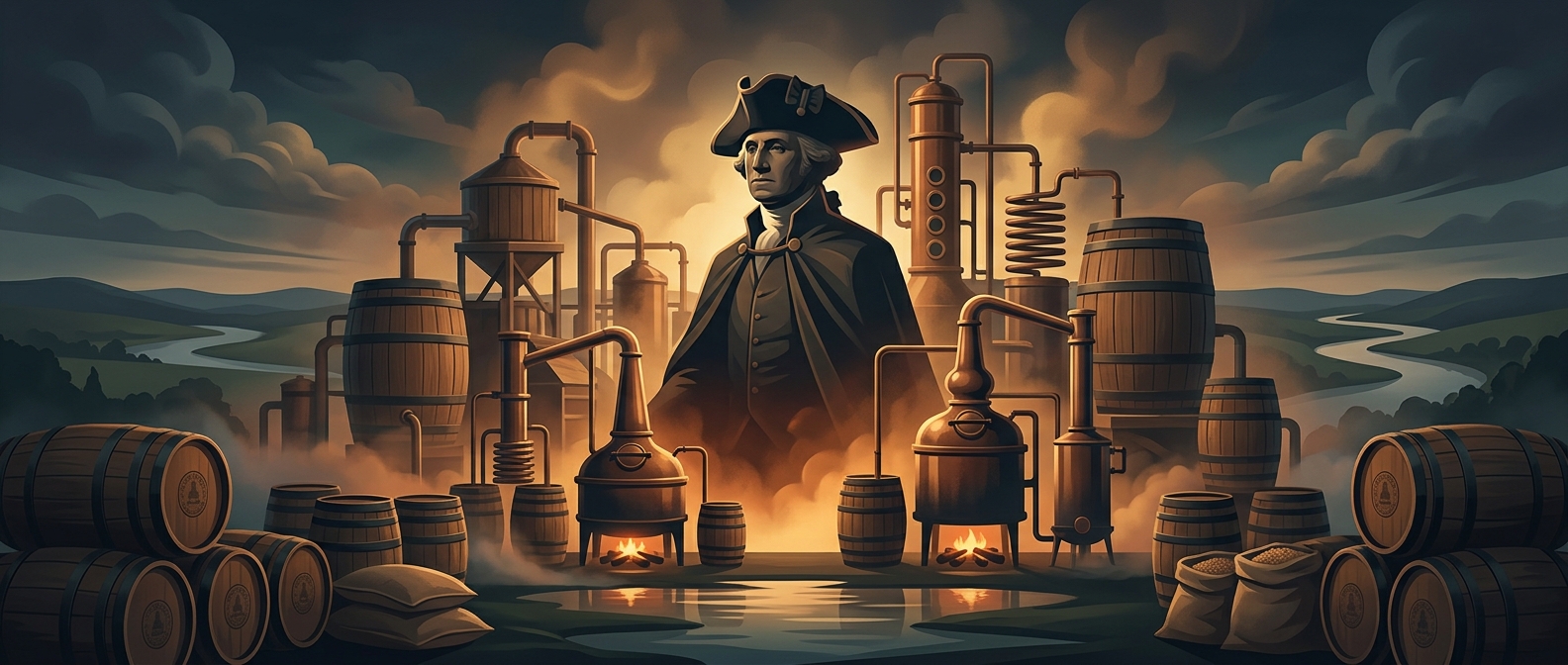
How a farm became a distillery
At Mount Vernon, whiskey-making was not simply a way to use up surplus grain. Distilling turned corn and rye—heavy crops that were costly to move—into a more compact product that could be stored and sold. The leftover mash could also be fed to livestock, allowing the operation to extract value from more of the harvest.
Washington’s Scottish farm manager, James Anderson, proposed expanding the work into a commercial enterprise. A purpose-built distillery began operating at Mount Vernon in 1797. Its output made the estate more than a collection of fields and workshops: it became a producer selling a finished good into the market.
The tax behind the political conflict
The federal government’s whiskey excise, enacted in 1791, charged a tax on distilled spirits. For small western farmers, whiskey was often a practical way to preserve and transport grain, so the tax could feel like a direct penalty on their livelihoods. Resistance grew into the Whiskey Rebellion, which Washington’s administration suppressed in 1794.
The same tax applied to commercial distillers such as Mount Vernon’s. The important economic distinction was scale: a large, organized operation could produce and sell whiskey in a way that made the business worthwhile even while meeting the tax obligation. Washington’s political opposition to the revolt did not mean his own enterprise stood outside the system; it operated within the federal market and its rules.
Turning production into profit
The distillery’s success reflected a practical calculation: use farm crops to make a product with greater value per load, then sell it. In 1799, it produced 11,000 gallons. That volume shows how far the operation had moved beyond household use—and how a government policy that provoked fierce resistance among some farmers could coexist with a profitable, large-scale business at the president’s own estate.