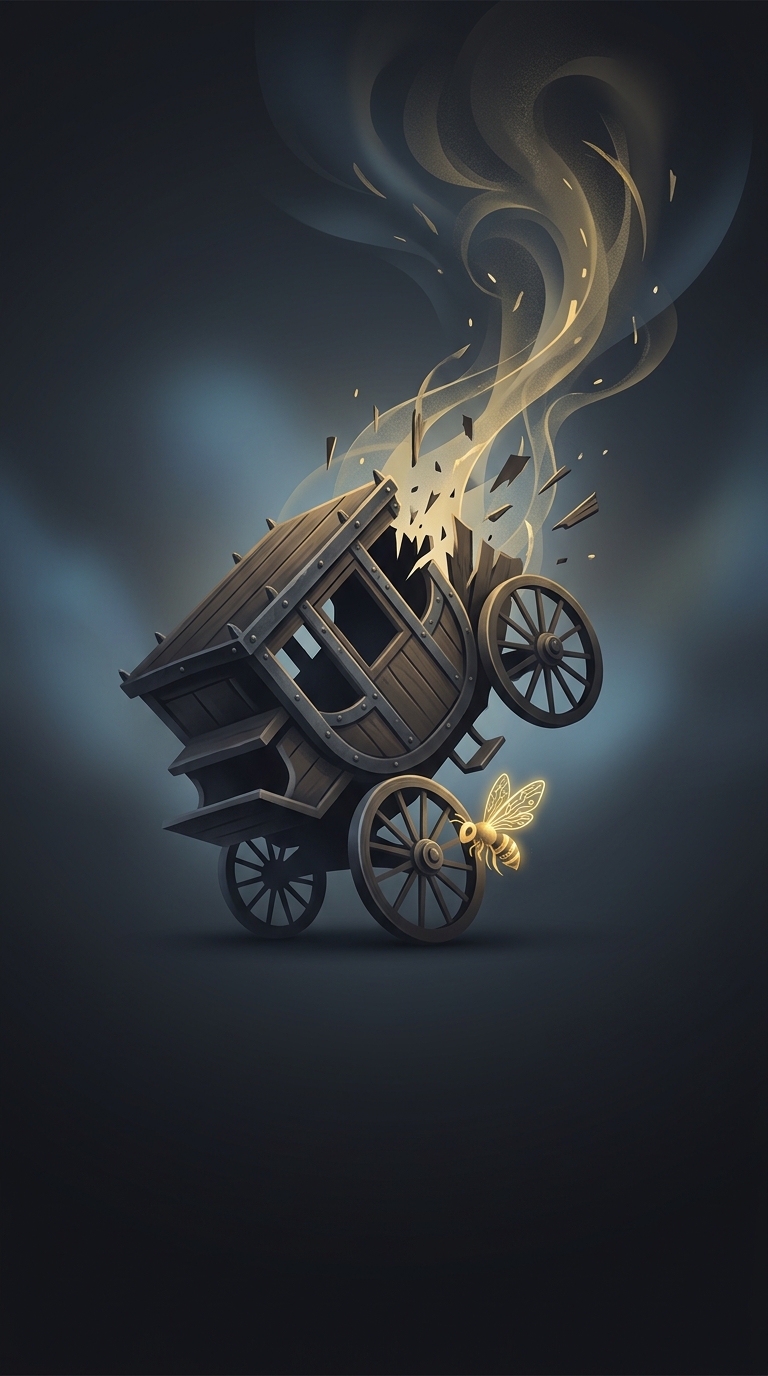
When a Bee Became a Physics Problem
A bee is tiny, but a game engine does not judge collisions by what looks important on screen. It checks invisible collision shapes—simplified boundaries around objects—and calculates how they should respond when they touch. If the bee’s boundary crossed the carriage’s path at just the wrong moment, the engine had to resolve that contact while the cart was already moving.
In a stable collision, the response is small and controlled. But a physics engine can produce an outsized impulse when moving objects overlap or their motion is difficult to reconcile. The bee did not need to be powerful; it only needed to become part of a bad calculation involving the carriage.
Why the Cart Went Flying
The carriage ride had to move convincingly through the world, while ordinary objects such as bees still obeyed collision rules. Those systems could clash: the bee’s contact prompted the engine to push the cart away, and the correction sent it soaring instead of keeping it on the road. The game was not simulating a realistic bee knocking over a wagon; it was exposing a mismatch in how the simulation handled contact.
That made the bug maddening to track down. The visible disaster was a carriage launching skyward, but the trigger was a small creature crossing an invisible boundary at the wrong time. In a physics-driven game, even scenery-sized details can become part of the machinery—and sometimes the smallest collision is the one that sends the whole ride into the sky.