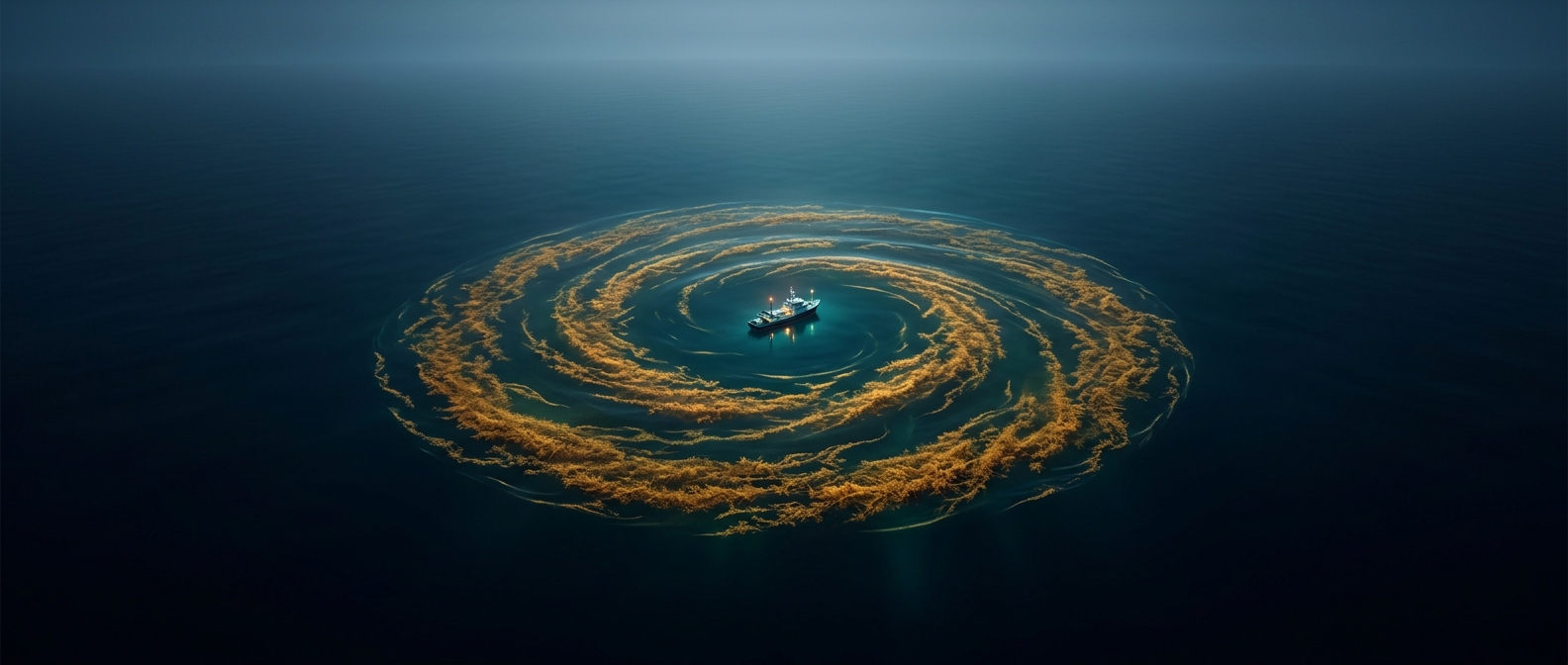
A sea drawn by moving water
The Sargasso Sea sits inside the North Atlantic’s great clockwise circulation, a system of currents called a gyre. Its edges are described by those currents rather than by coastlines: the Gulf Stream helps mark the west, while other North Atlantic currents shape its northern, eastern, and southern sides. These are moving boundaries, not lines you could trace on a map with perfect precision.
The circulation helps keep floating Sargassum—a brown seaweed that lives at the ocean’s surface—from dispersing evenly across the Atlantic. The seaweed has small, gas-filled bladders that help it float. As currents carry it around the gyre, patches can gather in the region, creating a distinctive open-ocean habitat.
A boundary that shifts with the currents
Because the currents vary, the Sargasso Sea does not have a fixed shoreline-like edge. Its extent can change, and the seaweed itself is not spread uniformly: winds and water movement can concentrate it into rafts or leave other areas relatively clear. The name describes a broad ocean region, not a still, enclosed pool.
That distinction matters when people encounter Sargassum on a beach. Seaweed washed ashore may have traveled far from the floating patches offshore, and its arrival depends on changing winds and currents. The Sargasso Sea’s most memorable feature is therefore also its defining mechanism: the ocean’s circulation both marks the region and helps gather the living material that gives it its name.