A First Walk Teaches the Game’s Physics
An opening movement lesson is really a quiet test of the game’s rules. The player presses a direction, but the character may take time to accelerate, keep drifting after the input stops, or turn more sharply than expected. These details determine whether movement feels weighty, nimble, or slippery—and they cannot be learned from a list of controls alone.
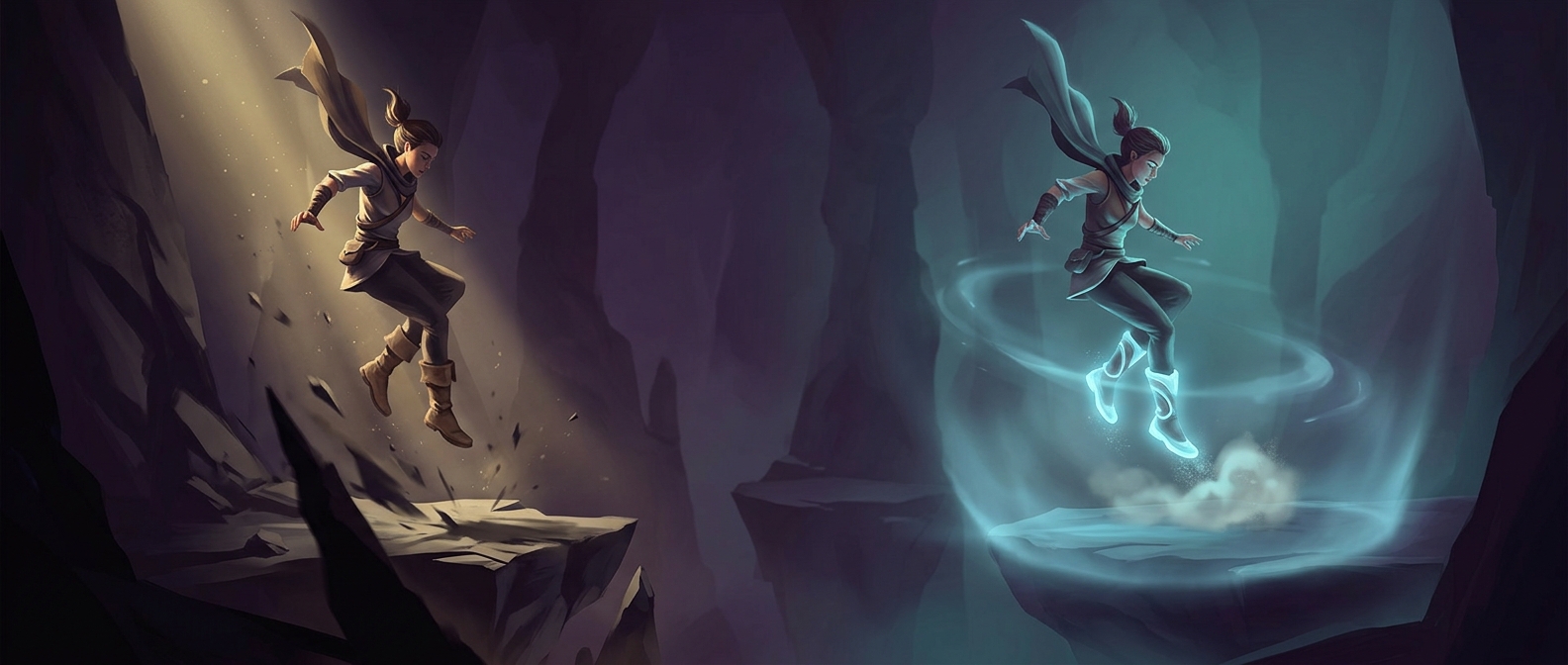
A short, safe stretch gives players room to build a mental model: how far the character travels, how quickly the camera follows, and how much space a jump covers. Once those expectations match the game’s behavior, players can judge gaps and obstacles without guessing at every step.
Why the First Obstacle Should Be Forgiving
A simple obstacle turns that model into a practical test. A jump across a broad gap, for example, teaches its timing and range while leaving room for error. If the same lesson appeared over a deep pit or amid enemies, a failed attempt could cost progress before the player understood what went wrong.
This is especially useful because familiar controls can disguise unfamiliar movement. Two games may both use the same button to jump, yet differ in how high the character rises, how quickly they reach the edge, or whether the camera makes distance harder to judge. Players bring habits from other games; the opening gives them a chance to adjust those habits to this character’s particular body.
Practice Before the Stakes Rise
Good early movement design therefore teaches through consequences that are easy to read. The player tries an action, sees how the character responds, and can try again with a better estimate. By the time the game asks for a precise jump or a quick turn, basic movement is no longer a mystery—and failure, if it happens, is more likely to feel like a choice the player made than a rule the game never explained.