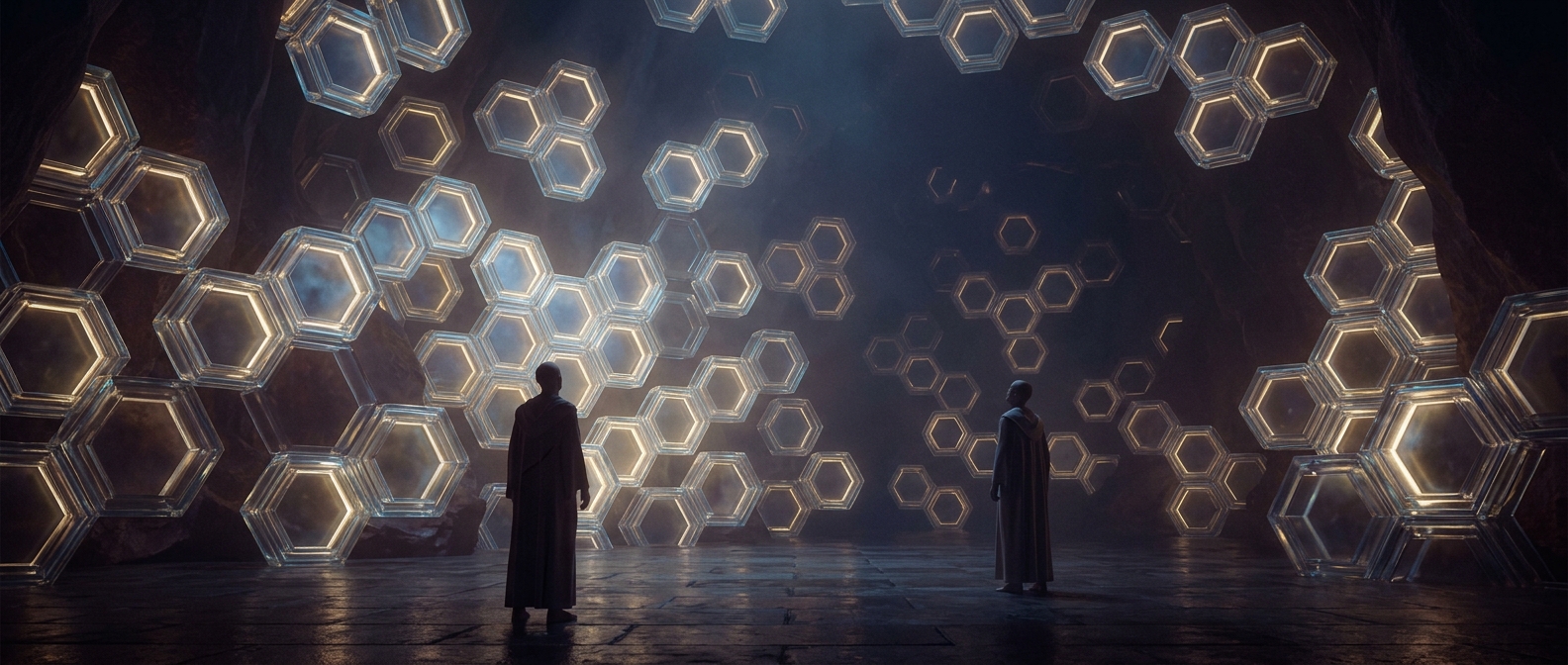
Why the Hexagon Suggests Order
A regular hexagon has six equal sides and angles, and copies of it can cover a flat surface with no gaps or overlaps. That makes it useful for packing space into a repeating pattern. Its geometry also gives each cell a relatively large interior compared with the length of its boundary—an advantage when neighboring cells can share walls.
In a honeycomb, cells meet along those shared walls, creating a compact structure rather than a collection of separate containers. The shape’s efficiency is real, though it does not mean every detail of a hive comes from a simple geometric calculation: bees build with wax, and natural comb can vary.
From Pattern to Symbol
The same features that make hexagons practical can make them feel meaningful to people: repetition, symmetry, and many parts fitting into one coherent whole. In mystical or spiritual interpretations, the hexagon may therefore stand for harmony, balance, or connection.
That symbolism is a human interpretation, not a property that geometry proves. Still, it draws on something visible in the shape itself: a small set of repeated cells can form an orderly surface, with each boundary serving more than one space. The honeycomb makes that relationship easy to see—structure and economy expressed in the same pattern.