Pisces Began as a Patchwork of Babylonian Sky Figures
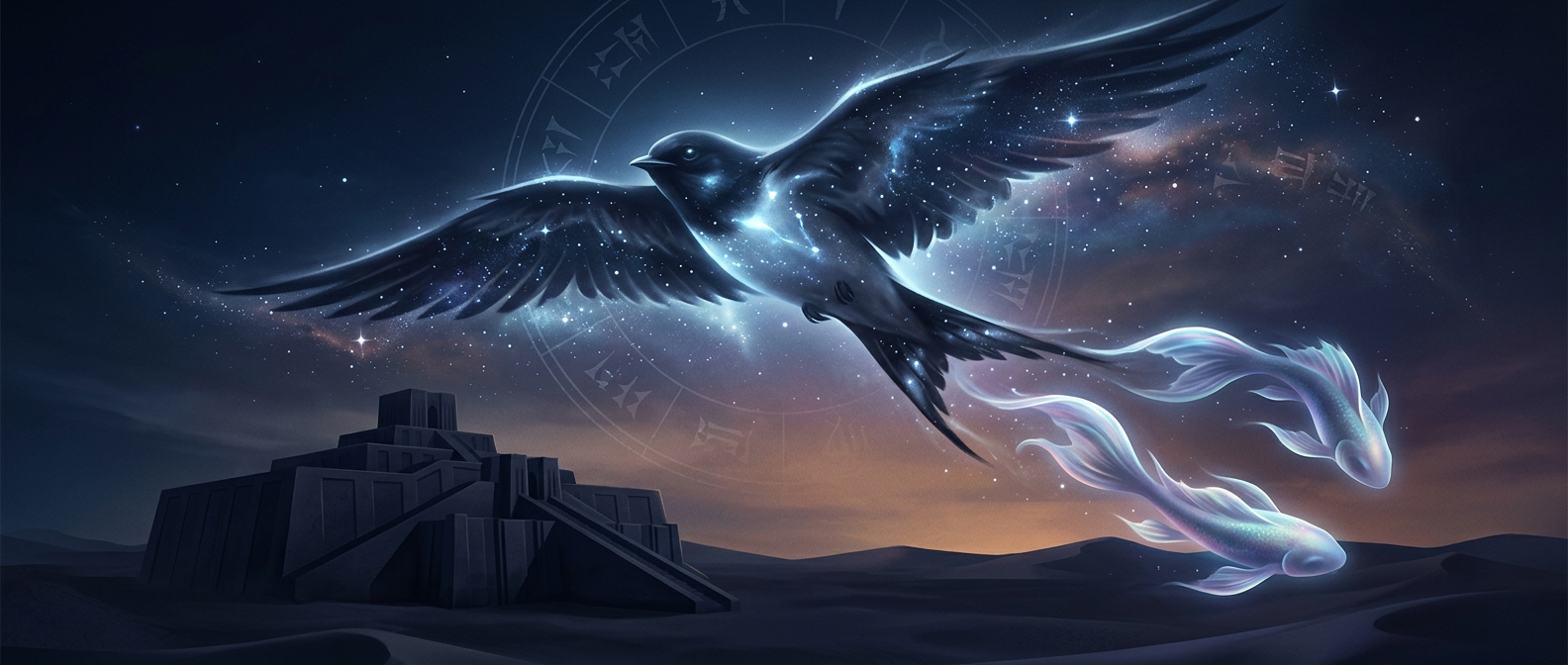
The familiar image of Pisces—two fish joined by a cord—was not the only way ancient Mesopotamians organized this part of the sky. Babylonian star traditions used names and figures that do not map neatly onto today’s zodiac signs. One name associated with the region was “The Tails,” while a swallow also appeared among the nearby celestial figures. That mix is the source of the striking swallow imagery.
A Constellation Was More Than a Picture
Ancient sky-watchers grouped stars into figures for keeping track of the heavens, but the boundaries and identities of those figures could shift across traditions and over time. A constellation name might refer to a whole star pattern, one part of it, or a neighboring figure. So a swallow in Babylonian sky lore does not necessarily mean that Pisces was once a single giant bird replacing the fish.
The later fish symbol preserves a different way of picturing the same stretch of sky. As Babylonian astronomical traditions were carried into Greek astrology, star groups and their meanings were adapted rather than simply copied. The result is a zodiac sign whose modern emblem can conceal an older, more crowded celestial map.
The Surprising Part Is the Overlap
The swallow and the fish are not just competing logos for Pisces. They point to how constellations are cultural maps: people connect the same stars into figures that make sense within different naming systems. When you see the two fish today, you are seeing the version that endured—not the only image ancient observers attached to that part of the sky.