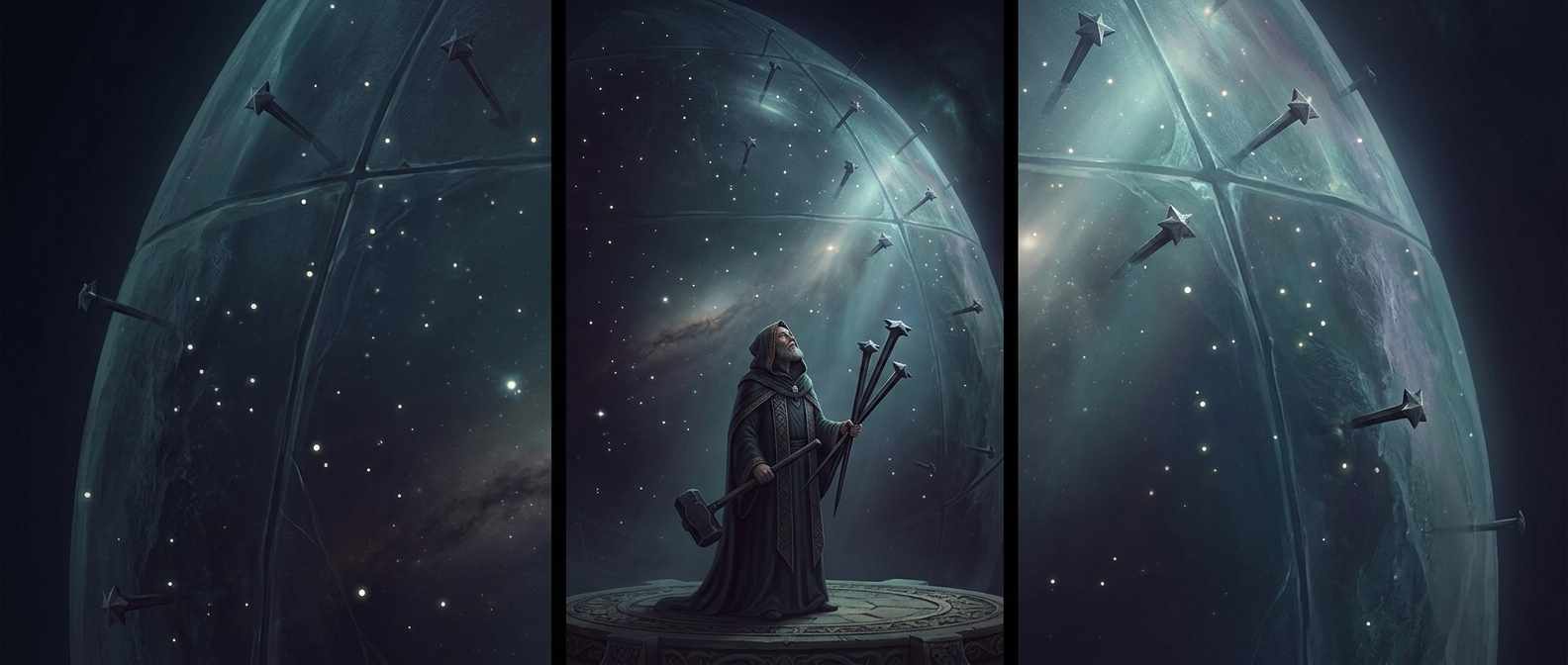
Why the stars seemed attached to a sphere
Watch the night sky over several hours and the stars appear to sweep across it together. Their patterns stay intact: the stars in a constellation keep nearly the same positions relative to one another, even as the whole pattern moves. The planets behave differently. Against that steady backdrop, they shift position over days and weeks—hence the ancient Greek word planētēs, meaning “wanderer.”
A rotating celestial sphere offered a simple way to picture the contrast. Earth sat at the center, the sphere turned around it, and the stars rode on its surface. In some ancient cosmologies, that surface was imagined as a real, transparent, crystalline shell, not merely drawn as a map.
A model that made the sky legible
The sphere explained the stars’ shared daily motion with one mechanism: turn the shell, and every star moves together while the patterns remain fixed. The planets could then be treated as moving separately against the sphere, tracing their own courses through the familiar star patterns.
This was a geometrical picture built from what observers could see without telescopes. “Fixed” did not mean the stars never moved in any sense; it meant their positions relative to one another appeared stable compared with the planets’ conspicuous wandering. The idea of a solid shell was one way some thinkers made that orderly picture physical.
From sky map to astrological framework
For astrologers, the stable background mattered because it gave planetary motion a consistent setting. A planet’s position could be described in relation to recognizable constellations and regions of the sky, making the heavens easier to chart and interpret. The imagined sphere joined two observations into one picture: the stars kept their pattern, while planets traveled across it.
The striking part is how closely the model followed the view from the ground. Every clear night, the starry “dome” seemed to turn as a single surface—with a few bright wanderers refusing to stay put.