Reconstructing the Route Through the Game
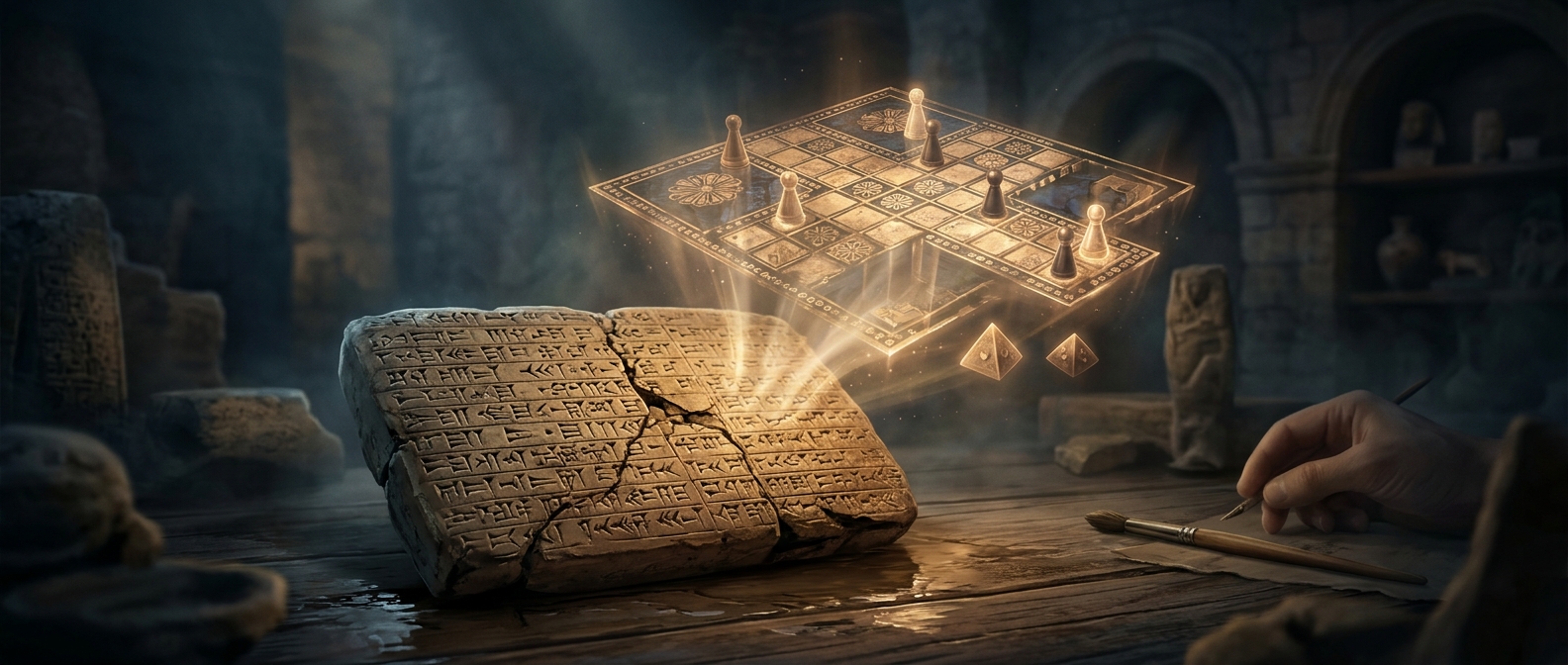
The board’s squares were not simply a grid to cross. In the modern playable reconstruction, each player moves pieces along a branching track, with the route weaving across the board before the pieces race toward the exit. Throws of marked tetrahedral dice—four-sided objects that land with one of two marked faces showing—determine how far a piece may move. Players must choose which piece to advance, balancing the chance to bring a new one into play against the risk of leaving another exposed.
A few special squares add turns or offer protection, so position matters as much as the luck of a throw. Landing on an opponent’s piece can send it back to the start. The result is a race with interference: a player can gain ground, but also disrupt an opponent’s progress.
What the Tablet Could—and Couldn’t—Tell Us
The rules were recovered from a cuneiform tablet: wedge-shaped writing impressed into clay. Its instructions gave the curator more than a board’s appearance; they described how pieces moved and what certain marked squares did. That made it possible to turn a buried game into something people could actually play, rather than guess at from surviving boards alone.
But a written rule set is not the same as a complete record of every local version or strategy. The playable game is a reconstruction from the tablet’s directions, interpreted alongside the physical boards. The remarkable leap was from marks on ancient clay to a sequence of choices at a table—one that still lets players feel how chance and tactical decisions could collide in a royal pastime.