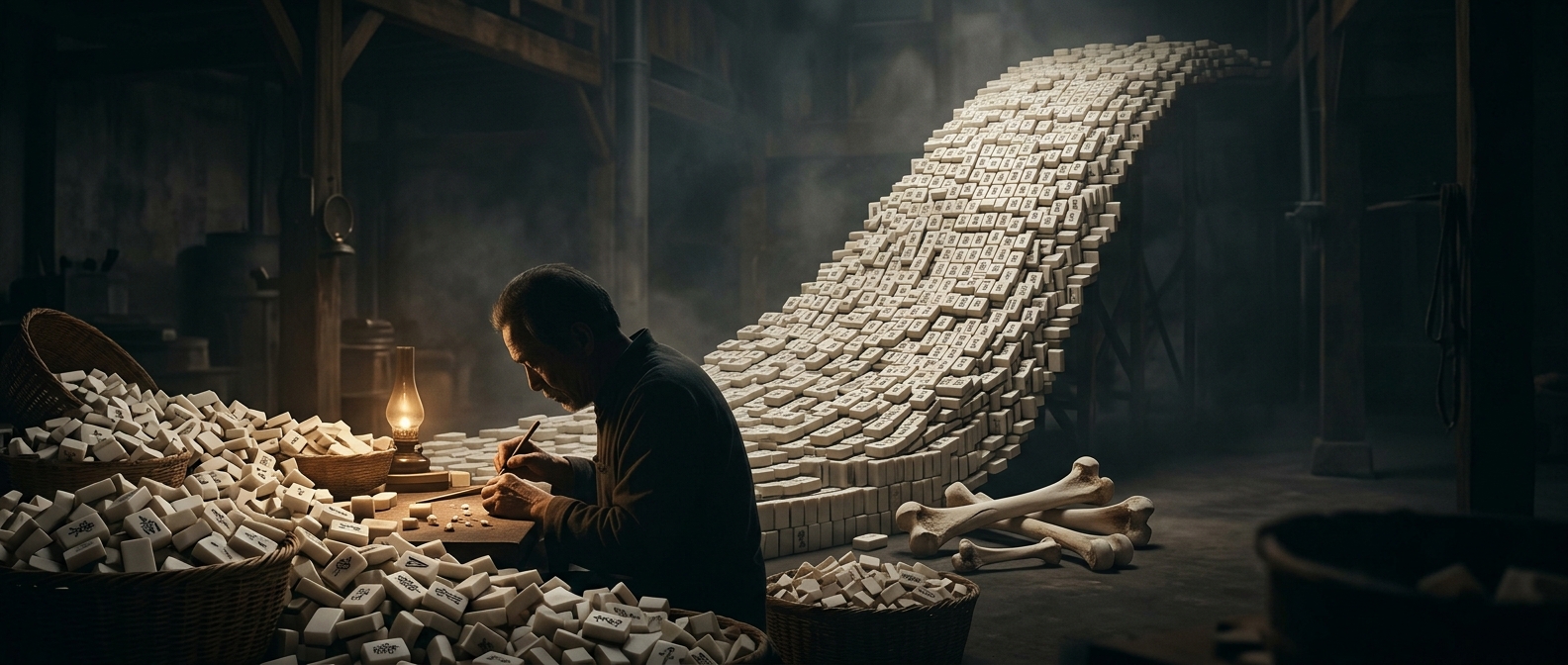
Why mahjong tiles needed cattle shinbones
Many traditional mahjong tiles were made as a composite: a hard bone face attached to a thicker bamboo backing. The bone supplied a smooth, durable surface for the symbols, while bamboo gave the tile body and helped conserve the costlier material. Cattle shinbones were useful because their dense bone could be cut into small, flat pieces suitable for tile faces.
From bone to a playable set
Making those faces meant turning an irregular natural material into many pieces of consistent size. Workers cut and shaped the bone, smoothed it, then carved or incised the markings—characters, circles, bamboo patterns, and other symbols. Pigment made the cuts easier to see. The finished face was joined to bamboo, producing a tile sturdy enough to handle repeatedly.
That construction tied mahjong production to a supply of animal bone. As factories made tiles for buyers far beyond their local markets, they needed large quantities of material that could be prepared in uniform pieces. Buying shinbones in bulk helped turn a once-handcrafted object into something factories could produce in volume.
The result was a set that concealed its material bargain in plain sight: the distinctive symbols sat on bone, but the whole tile did not have to be carved from it.