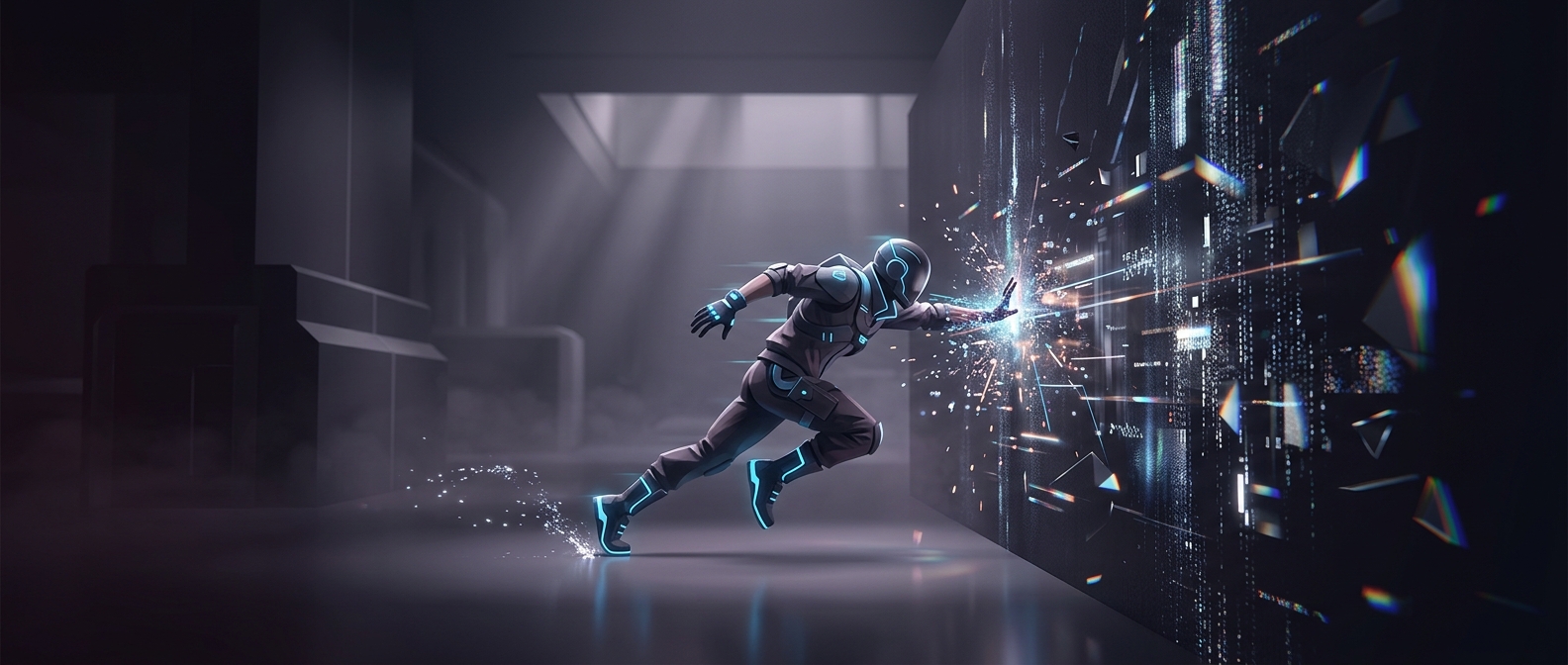
How a corner becomes a shortcut
A game world is built from two overlapping systems: the visible scenery and invisible collision shapes that decide where an avatar can move. A wall may look solid because the game checks the avatar’s position against one of these shapes and blocks movement when they intersect.
Clipping happens when those checks fail to keep the two systems in agreement. In some games, movement is calculated in discrete steps. If the avatar is pushed against a wall or into a tight corner, the game may resolve overlapping collision shapes imperfectly—shifting the character in an unexpected direction, or placing it just past the barrier. Once the avatar is on the other side, the wall no longer prevents movement through that space.
Why the corner matters
Corners bring multiple collision surfaces together, creating a tricky situation for the game’s movement and collision rules. Repeatedly pressing into the junction can make the character’s position or momentum accumulate in a way the developers did not intend. The exact technique varies by game: it may depend on movement speed, input timing, the avatar’s shape, or how the engine resolves collisions.
That is why a maneuver that looks like simply leaning into a wall can require careful positioning and repeated attempts. The runner is not removing the wall; they are exploiting a gap between the game’s rules for movement and the boundaries the level is meant to enforce.
Turning a flaw into a route
For a speedrunner, the useful question is what lies beyond the boundary. If clipping lets the avatar enter a later section, skip a long traversal, or reach a goal from an unintended direction, the risky maneuver can save more time than it costs to attempt. Runners test the setup, learn where it works, and build the successful route into a practiced sequence.
The result is a map with two versions: the route players are guided through, and the route permitted by the game’s underlying collision logic. A wall can remain visually intact while ceasing to be a meaningful obstacle.