Why the Midnight Sun Circles the Arctic
The midnight sun is a consequence of Earth’s tilted axis. During Northern Hemisphere summer, the North Pole leans toward the Sun. As Earth turns, places far enough north rotate through the side of the planet facing sunlight without passing into darkness. The Sun may dip toward the horizon, travel along it, and rise again—but never disappear below it.
This happens north of the Arctic Circle, though the length of continuous daylight depends on latitude. Near the circle, the phenomenon lasts around the summer solstice; farther north, it lasts longer. At the North Pole, the Sun can remain above the horizon for roughly half the year, tracing a slow circle across the sky before sinking below it in autumn.
A Different Kind of Daylight
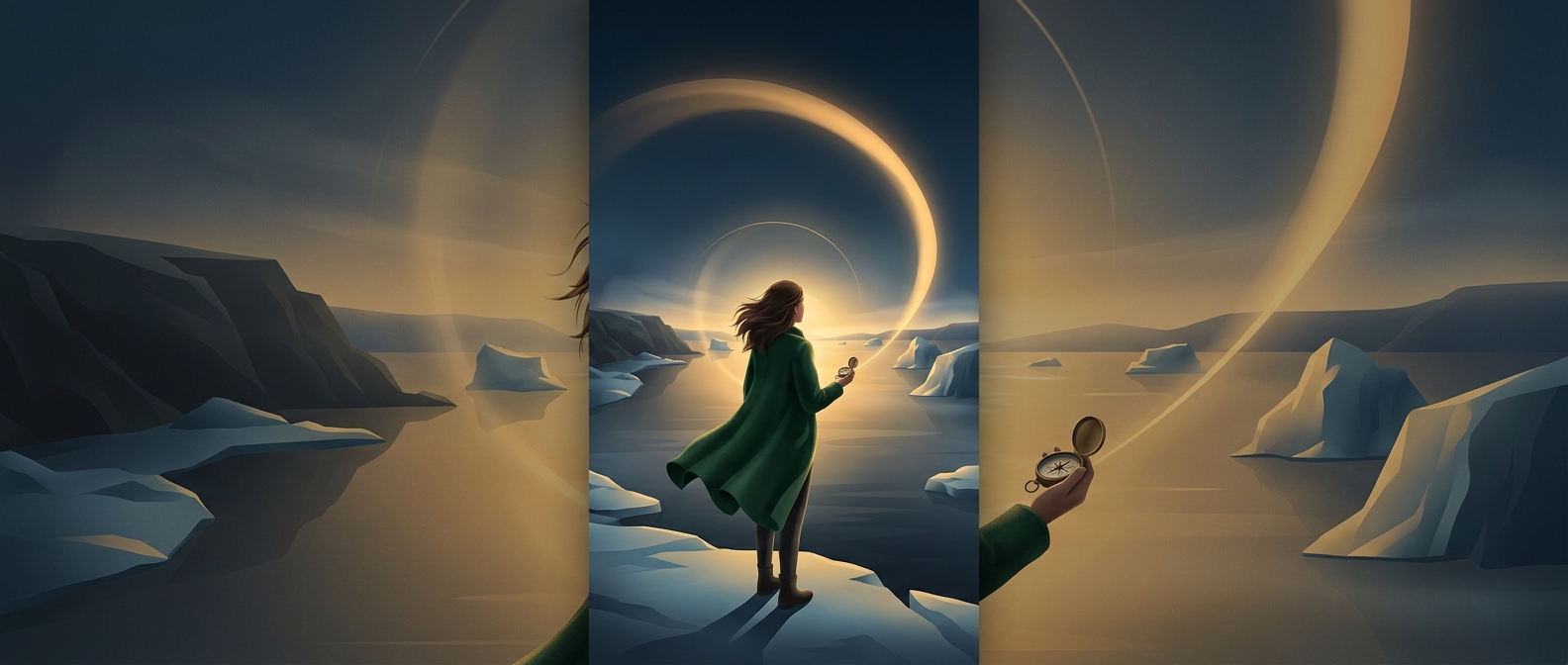
The Sun does not stay high overhead throughout the nightless period. Near the solstice, it often hangs low in the sky, casting long shadows and changing the color of the landscape as it approaches the horizon. That low arc is what makes the experience feel unlike an ordinary noon: the light persists, but its angle keeps shifting.
For visitors, the result is a destination whose outdoor day has no clear visual endpoint. A late walk or excursion can unfold in sunlight at an hour when the body expects darkness. The brightness is temporary, however: as Earth continues its orbit, the pole gradually tilts away from the Sun, and night returns. The endless-looking day is a seasonal loop, not a permanent feature of the Arctic.