What “Om” Means in Practice
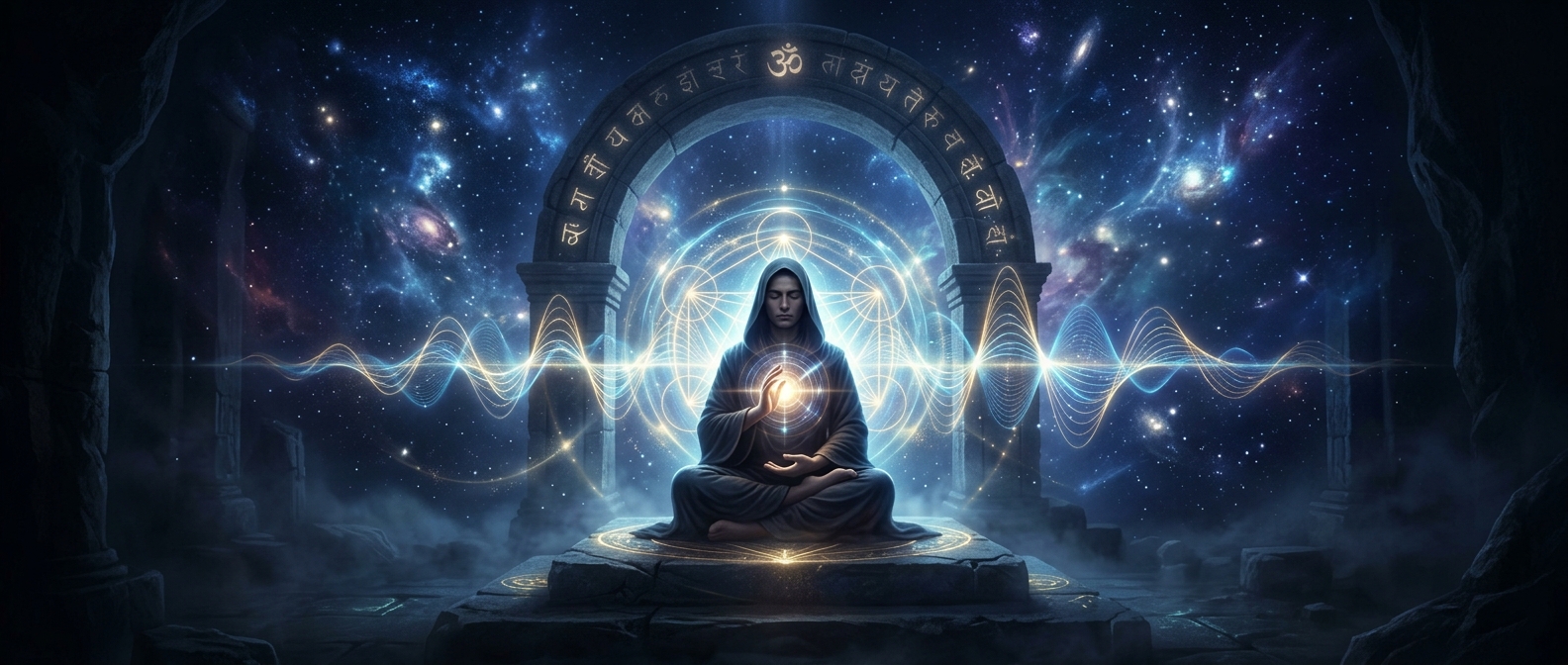
In Hindu traditions, Om—often written Aum—is treated as a sacred syllable that can stand for ultimate reality or the totality of existence. Its meaning is not simply “a sound that matches the universe.” For practitioners, chanting it can be a way to focus attention on a reality understood as deeper than ordinary, separate things.
How a Chant Becomes a Meditation
A common practice is to let the sound unfold slowly: an open “ah,” a rounded “oo,” and a closing “mmm.” The voice and breath make the syllable tangible. Attention can follow it from the start of the exhale to the fading resonance, giving the mind a simple task instead of letting it jump among thoughts.
The low, sustained closing sound may also be felt as vibration in the face or chest. That physical sensation is real, but it does not demonstrate that the chant produces a measurable vibration of creation. The larger claim belongs to a spiritual interpretation of the sound.
Resonance as a Spiritual Image
The idea of resonance connects a small human act—one person breathing and chanting—with a much larger account of existence. In that sense, the chant is both a devotional symbol and a repeatable contemplative practice. Its significance lies in how practitioners understand and use it, not in treating a metaphor about cosmic vibration as a scientific measurement.