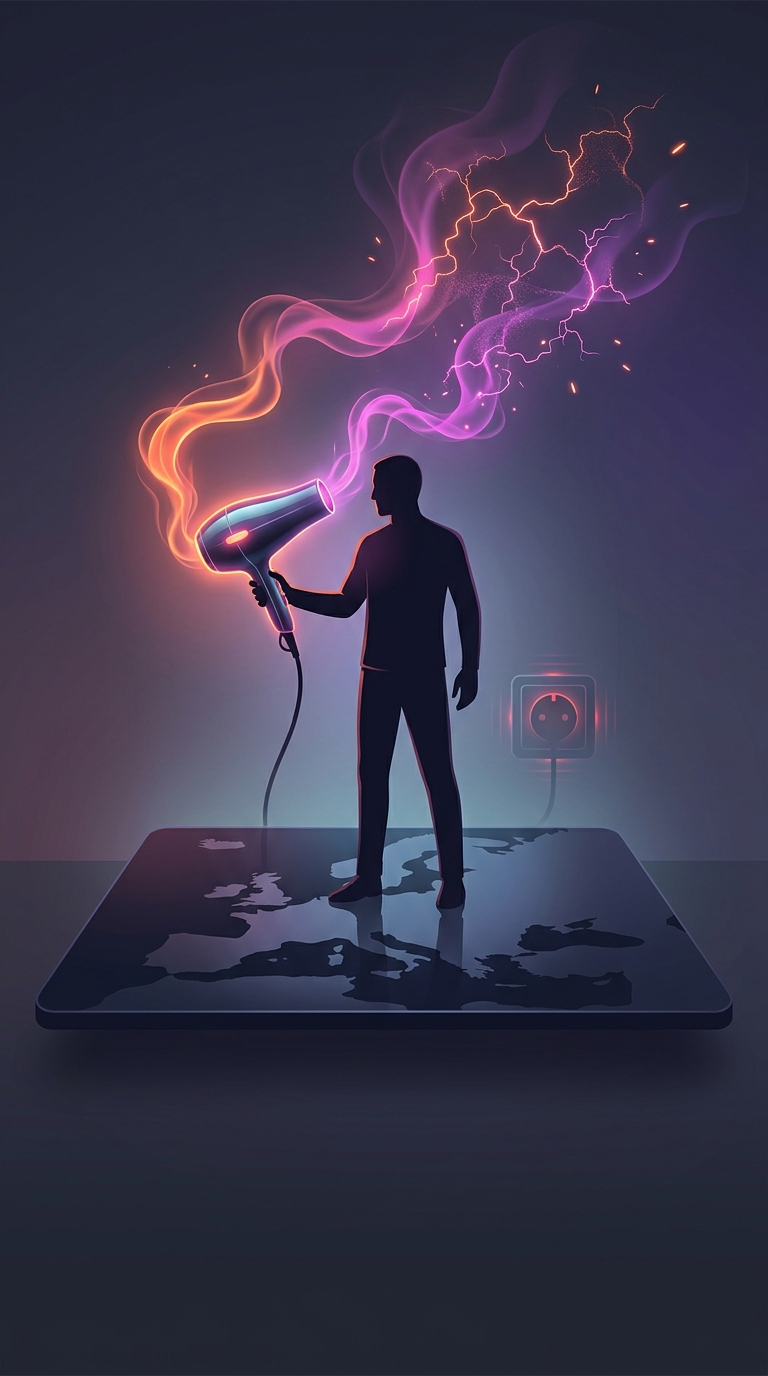
A plug adapter changes the shape, not the electricity
A cheap travel adapter lets a plug fit a European outlet. By itself, it does not change the outlet’s voltage. Much of Europe’s household electricity is around 230 volts, while many hair dryers made for the United States are designed for about 120 volts.
That mismatch matters because a hair dryer draws substantial power to heat air and run a motor. Give a 120-volt dryer a supply near 230 volts, and its heating element can take far more electrical power than intended. The dryer may overheat, fail, or damage its wiring; smoke and flames are possible outcomes, not just a blown fuse.
Why a small adapter can hide a big mismatch
The adapter may look like a harmless connector, and the dryer may switch on, but neither fact means the appliance is receiving suitable power. A voltage converter is a different device: it changes the voltage. Even then, it must be rated for the dryer’s power demand and compatible with its motor and heating element. A small converter intended for a phone or camera is not enough for a hair dryer.
Some dryers are dual-voltage, meaning they can operate on both 120 and 230 volts. Check the label or manual for a range such as “100–240 V,” and set the dryer’s voltage selector correctly if it has one. If the dryer is marked only for 120 volts, a plug adapter alone is not safe. The practical consequence is simple: before packing a hair dryer, check its voltage rating—not just whether its plug can be made to fit.