How a Game Fills the Gap Between Frames
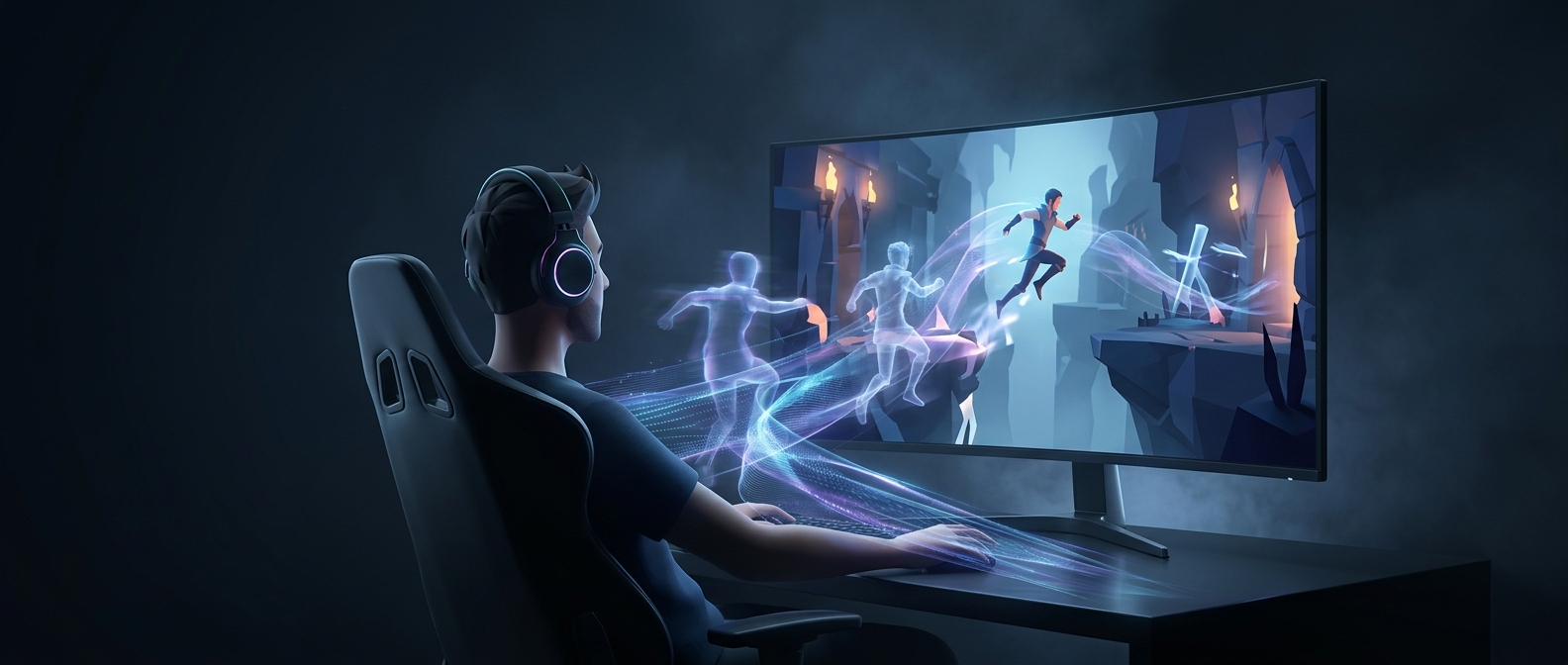
A renderer normally builds each image from the game’s current camera, geometry, lighting, and animation. Frame interpolation takes two completed images—one before and one after a moment—and estimates how objects moved between them. It can then draw a plausible intermediate image without asking the game to render a full new scene for that instant.
A common approach is to estimate motion vectors: little directional clues describing how parts of the image appear to shift. If a character’s hand is in one place in the first frame and farther along in the next, the software predicts where it would fall between those positions. It applies similar estimates across the scene, then combines image information to construct the in-between frame.
Why the Guess Can Look Wrong
The two images do not always reveal what happened between them. A fast-moving sword may jump across the screen, leaving the software unsure of its path. A newly exposed background—such as a wall revealed when a character moves aside—was hidden in the earlier frame, so there may be no reliable pixels to place there. Thin objects, motion blur, and overlapping characters can also confuse the estimate.
That is why a generated frame is a prediction, not a newly simulated moment. It may smooth motion while briefly warping an edge, smearing a detail, or making an object appear to bend. The larger the gap between the real frames, the more the software has to infer.
Smoothness Versus Responsiveness
Generated frames can make motion look more fluid when a game cannot render enough images per second on its own. But the game still processes player input and updates its world on its real rendered frames; inserting pictures does not make those underlying updates happen more often. Depending on how the technique is implemented, creating frames can also add delay.
The practical tradeoff is visible: interpolation can make a camera pan feel smoother, yet a newly pressed button may not affect every displayed image. The screen gains visual steps, not necessarily additional moments in the game’s simulation.