Why a Flamingo Can Mark a Route Across the Salt
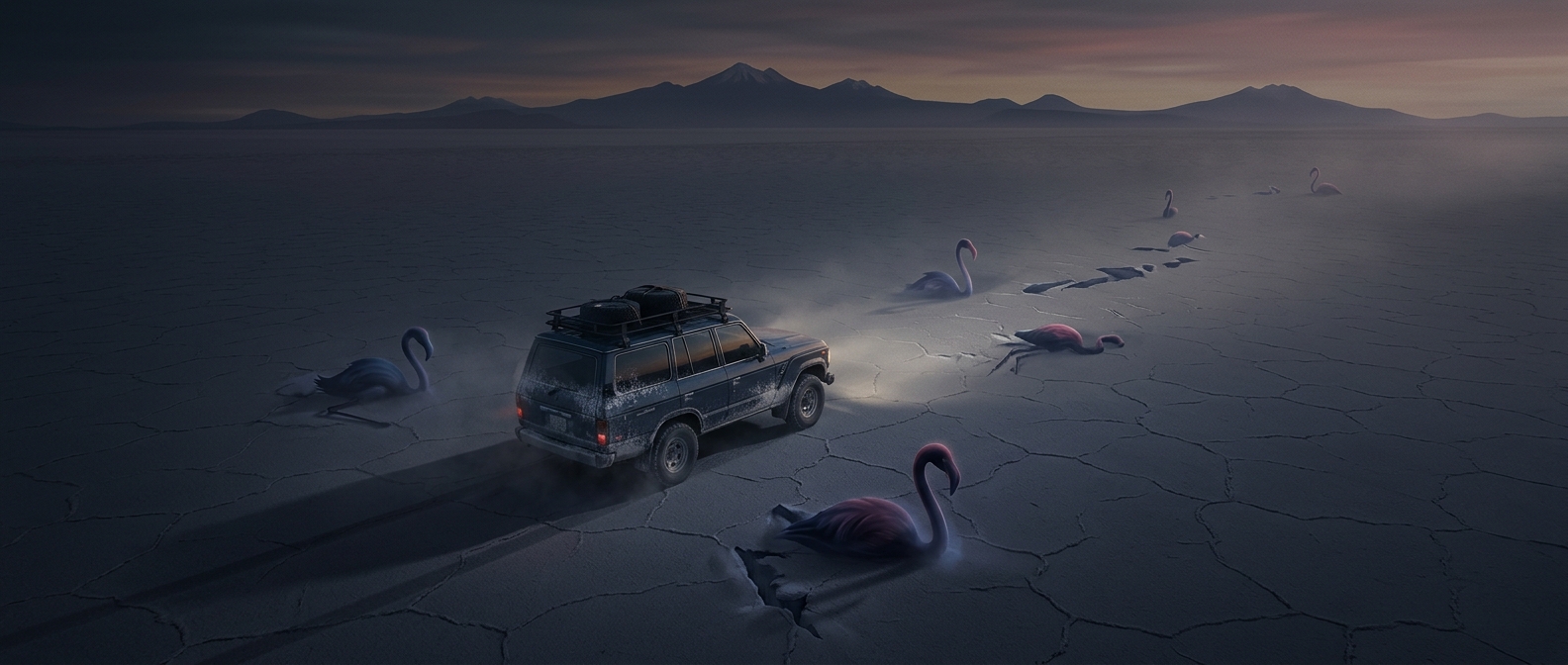
On Bolivia’s broad salt flats, the ground can look like a nearly unbroken white sheet. With few nearby features to judge distance or direction, a driver can lose a sense of where the vehicle is headed even when the horizon seems clear. Distant peaks help, but a low object on the surface can be a more immediate reference point.
A mummified flamingo stands out against the pale salt. Its shape and color break the visual sameness, giving drivers a recognizable point to steer toward or use to check their position. Here, “mummified” means naturally dried out rather than deliberately preserved; a dried body can remain visible long after the bird has died.
Navigation by What the Landscape Leaves Behind
Salt ridges, mountain peaks, and bird remains serve different scales of navigation. A mountain can orient a driver across a wide area; a ridge or carcass can help identify a local stretch of the route. None is a precise marker like a sign or a painted road line, but together such landmarks make an otherwise sparse landscape easier to read.
The useful detail is the contrast: on a surface that offers almost no visual pattern, even the remains of a single bird can become part of the way people find their way across.