Why salt needed a border
Salt was essential to daily cooking and food preservation, but Britain’s colonial government in India taxed it as a source of revenue. The tax made salt produced or sold outside official channels cheaper than government-taxed salt, creating an incentive to carry it across the boundary without paying. To collect the duty, officials had to control not just production but movement.
A barrier made of plants
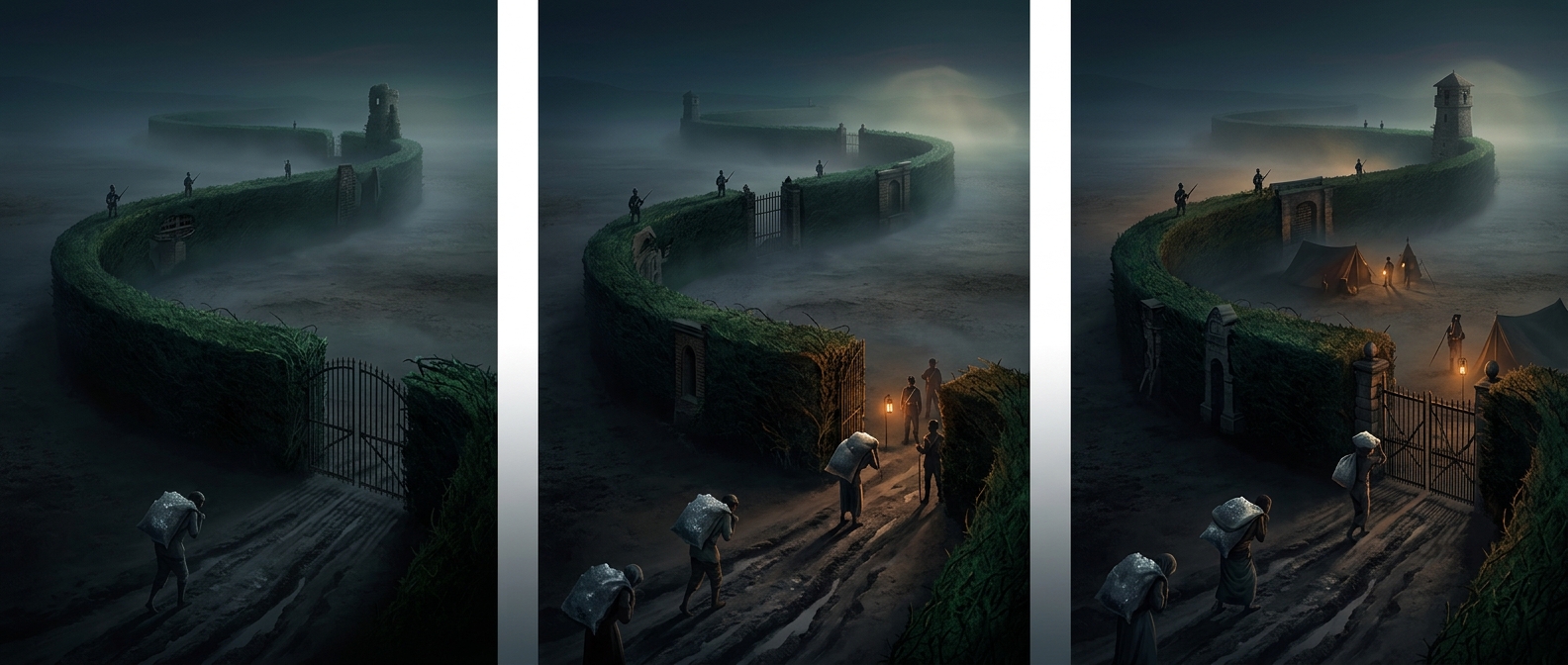
The Inland Customs Line was a long checkpoint system running across the subcontinent. In places, thorny shrubs and trees were planted and woven into a dense hedge, turning an administrative boundary into a physical obstacle. Guards watched for gaps and searched people and goods for untaxed salt. The vegetation could slow a crossing, but the line also depended on people to patrol it: a hedge could not identify a smuggler or collect a tax by itself.
The system’s scale reflected the difficulty of enforcing a tax across a vast territory. Its route shifted over time, and the hedge was not one unbroken wall of plants; it included stretches strengthened by vegetation alongside other forms of surveillance and control.
The cost of taxing an everyday necessity
For the colonial state, the line helped protect revenue by making evasion harder. For ordinary people, it meant that a basic ingredient could be subject to checkpoints and searches, while the tax raised the cost of an indispensable good. The hedge made that imbalance visible: a government had built a landscape-scale barrier to regulate who could carry salt—and who had to pay for it.