How the Fifth-Wheel Hitch Carries a Heavy Trailer
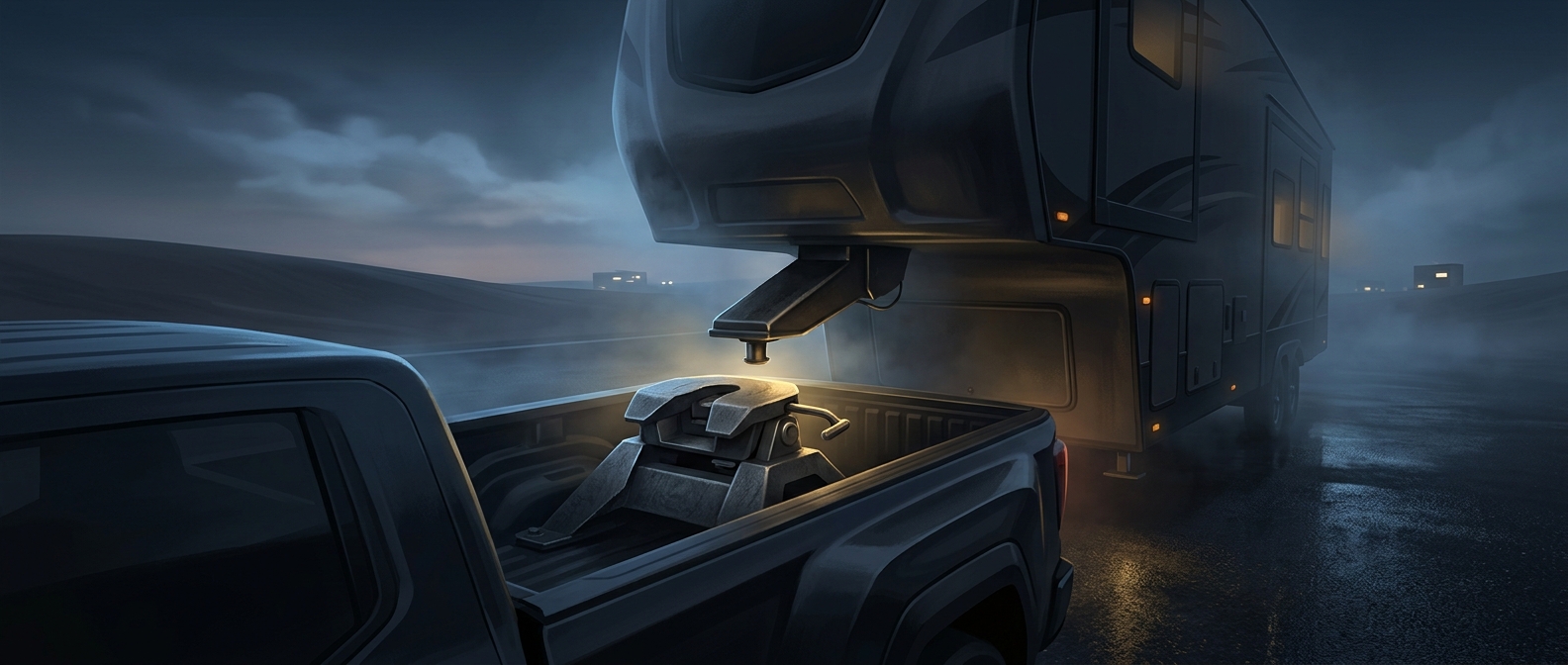
At the front of a fifth-wheel trailer, a short steel pin called a kingpin extends downward from the trailer’s overhanging front section. It drops into a hitch plate mounted in the truck bed, where a set of locking jaws closes around it. The pin-and-jaw connection is designed to keep the trailer attached while allowing it to move relative to the truck.
That connection changes how the load reaches the truck. Instead of pulling only from a receiver behind the bumper, the trailer bears down through a hitch inside the bed. Some of its weight presses onto the truck, while the truck’s rear axle supports the hitch. The arrangement can make a large trailer feel more settled under tow, though the truck still has to be rated for the trailer’s weight and the load on its axles.
The Pivot Matters in a Turn
The hitch plate lets the trailer swing sideways as the truck turns, with the kingpin acting as the pivot. The trailer’s front overhang can move over the bed rather than being forced to follow the truck’s exact path. This articulation is what lets a long combination of truck and trailer negotiate turns without the trailer behaving like a rigid extension of the cab.
The tradeoff is that the hitch occupies the bed, and the trailer’s front can approach the truck’s cab during a tight turn. Short-bed trucks may need a sliding hitch or another clearance solution to reduce that risk. Before driving, the jaws must be fully locked around the kingpin; a hitch that looks connected but has not latched properly can separate under load.