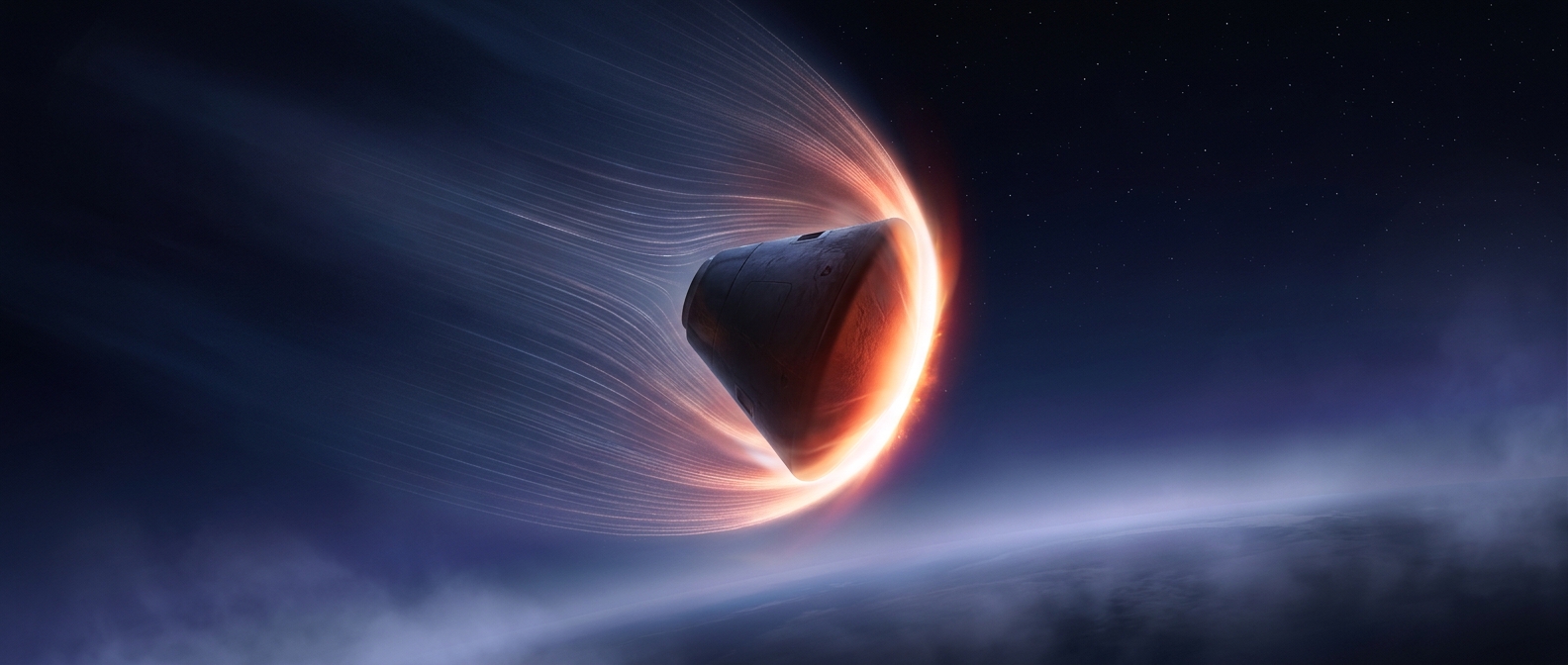
Why a returning capsule meets the air head-on
A capsule coming back from the International Space Station is still moving at orbital speed—roughly 28,000 kilometers per hour. The atmosphere does not act like a soft cushion at first. At those speeds, even its thin upper layers exert enormous force, and the vehicle must shed energy without letting the heat or deceleration overwhelm the spacecraft and its crew.
The capsule’s broad, blunt front is part of the solution. It forces air to pile up and divert around the vehicle, forming a shock wave ahead of the hull. The air in this compressed region becomes extremely hot. A heat shield protects the capsule by insulating it from that heat or, in some designs, carrying heat away as material chars and erodes. The shield is not simply a tough outer shell: it is a layer engineered to take damage so the cabin does not.
A narrow path through a violent descent
The capsule must enter at the right angle. Too steep, and it can lose speed and altitude so quickly that the forces become dangerous; too shallow, and it may skim the atmosphere instead of descending as planned. Its shape and orientation help create aerodynamic lift—the force that lets pilots or guidance systems steer a little, rather than merely fall straight down. Small adjustments can keep the capsule within its safe corridor, though it cannot maneuver like an airplane.
As it drops into denser air, drag steadily reduces its speed. The crew may feel several times Earth’s normal gravity during this phase, because the capsule is slowing so rapidly. The heat shield handles the intense heating early on; only after the craft has lost most of its orbital speed can parachutes safely take over.
Why parachutes come late
Parachutes would be torn apart or provide little useful control if opened while the capsule was still moving too fast. After the atmosphere has done the hardest braking, a sequence of parachutes deploys to slow the vehicle for its final landing. Depending on the spacecraft, that landing may be on land or in the ocean.
The striking part is that the capsule does not need engines to brake through most of the return. It uses the atmosphere as a brake, while its shape, heat shield, and carefully timed parachutes make that braking survivable.