How a growing plant makes spiral rows
In a sunflower head, the seeds are not individually placed into neat spirals. They develop from tiny new growths around a central growing region. As each new seed-forming structure appears, the stem tip grows and shifts the place where the next one can form. This repeated process creates spiral-looking rows across the head.
The key is the angle between successive new growths. When that angle is close to 137.5 degrees—often called the golden angle—each new growth tends to land in an open space rather than directly behind an older one. That helps distribute seeds across the available surface as the head expands.
Why Fibonacci numbers show up
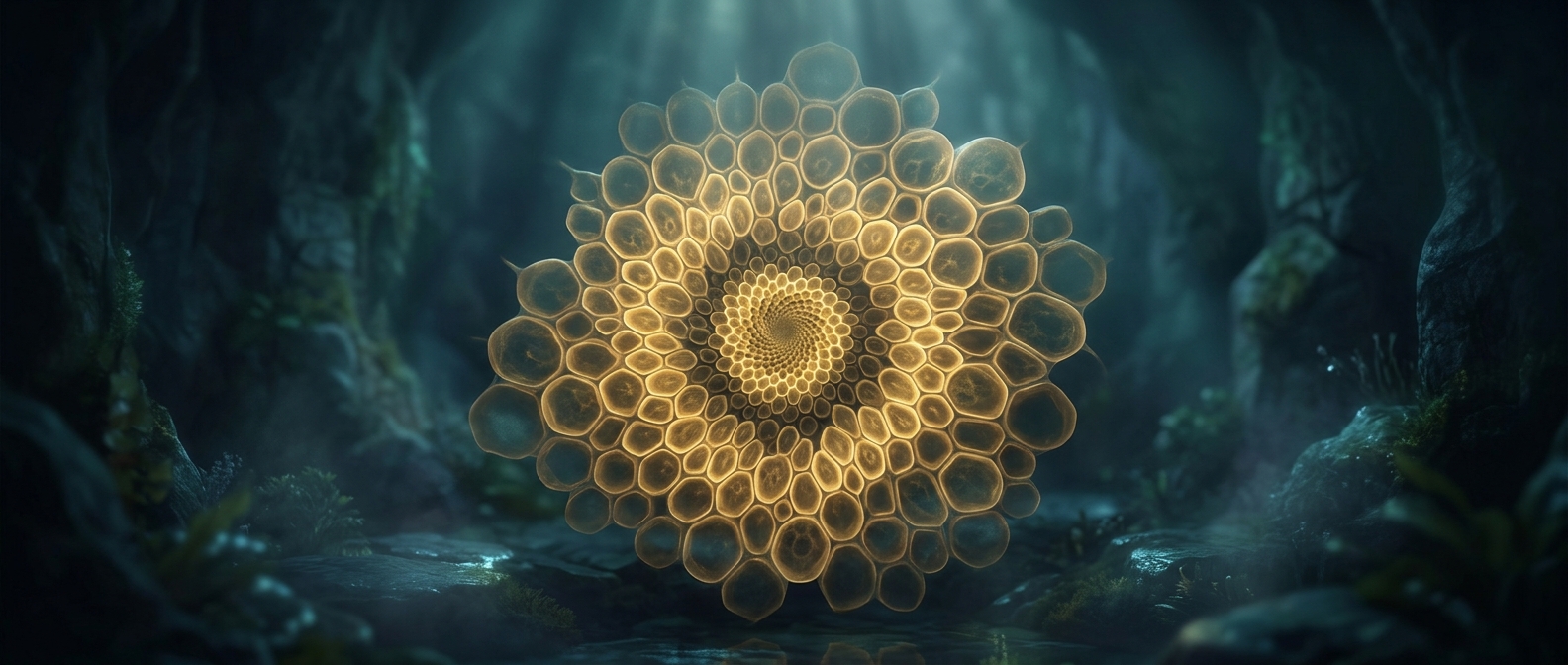
The visible spirals are not grooves laid down by a hidden pattern. They are paths the eye can trace through neighboring seeds. In many sunflower heads, the spirals winding in opposite directions number consecutive Fibonacci numbers, such as 34 and 55. The Fibonacci sequence is made by adding each pair of numbers to get the next.
That connection follows from the repeated placement angle: because it does not line up neatly with a simple fraction of a full turn, new growths keep filling different gaps. The resulting arrangement can use space efficiently without requiring the plant to calculate or “know” Fibonacci numbers. Spiral counts vary with the size and growth of the flower head, and not every plant displays the same counts.
The striking pattern is therefore a visible consequence of growth rules repeated many times. A seed head can look mathematically designed, while its structure emerges from where each new seed-forming unit can fit as the plant grows.