What Makes a Spiral “Golden”
A logarithmic spiral keeps the same shape as it grows: turn it around its center, and its curve can be matched by scaling it outward. In polar coordinates, its distance from the center increases exponentially with the angle. That steady growth pattern—not simply a spiral that looks pleasing—is what defines the geometry.
A golden spiral is one particular logarithmic spiral. Its radius grows by the golden ratio, about 1.618, for every quarter-turn. The golden ratio is a fixed proportion found by dividing a line so that the whole is to the larger part as the larger part is to the smaller. Choosing that growth rate gives the spiral its distinctive, steadily widening form.
A Construction Is Not the Same as a Natural Pattern
The familiar drawing method starts with a golden rectangle: remove a square, then repeat the process with the smaller rectangle left behind. Quarter-circle arcs drawn inside the squares create a close visual approximation. The exact golden spiral, however, is a continuous curve; it is not literally a chain of those arcs.
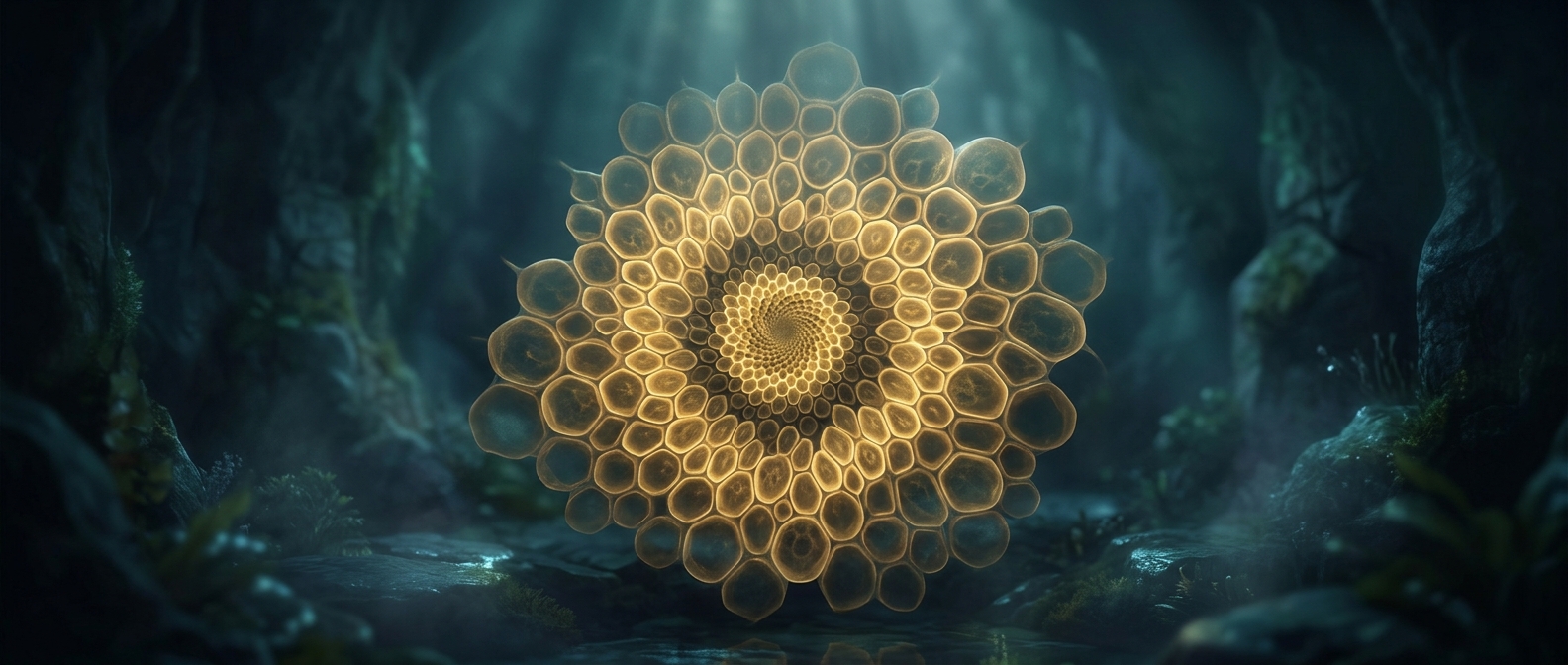
This distinction matters when people point to shells, storms, or plants as examples. Nature produces many kinds of spirals, shaped by different growth and physical processes. A curve can widen in a similar way without following the golden ratio. The golden spiral is therefore a precise mathematical case, not a universal template hidden in every spiral-shaped object.