Turning theology into a machine
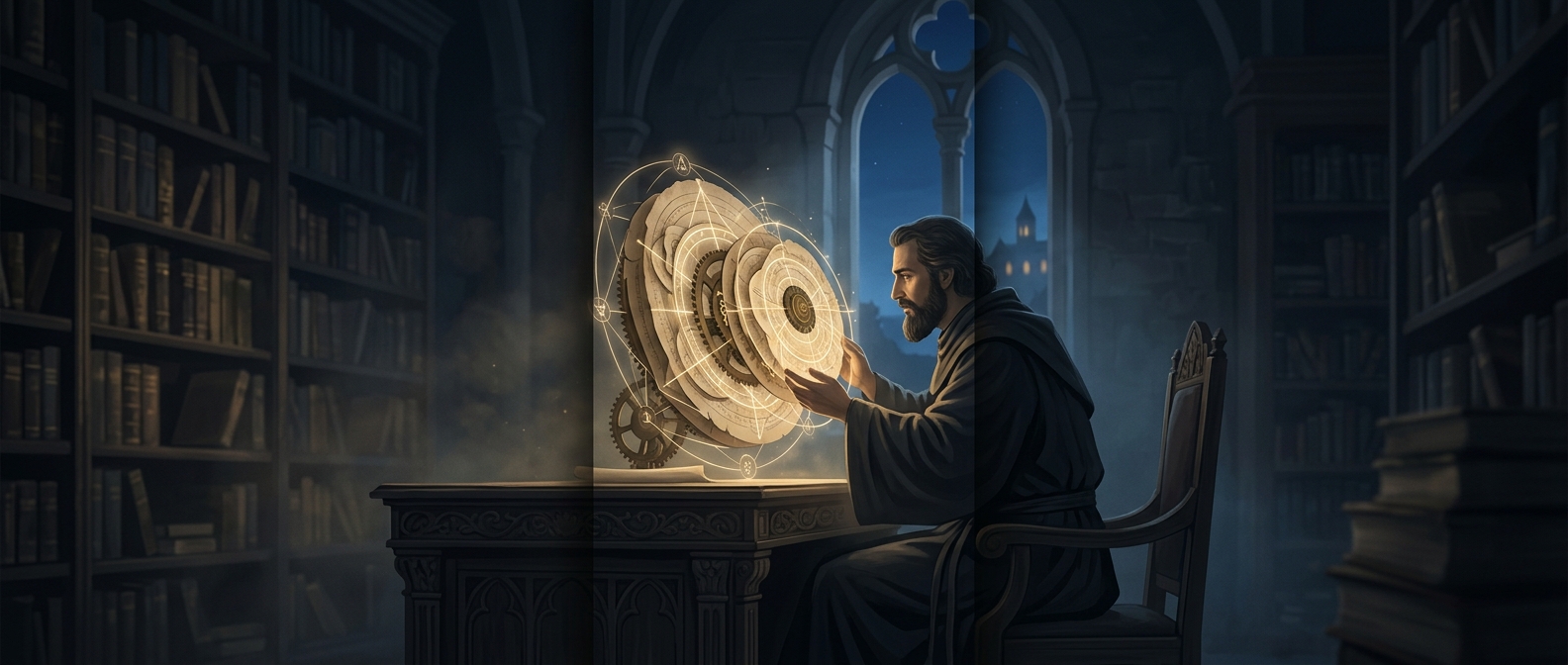
Ramon Llull’s paper devices made an abstract religious argument something a reader could manipulate. In his system, letters stood for basic divine attributes—such as goodness, wisdom, and power. These symbols were arranged on rotating discs, or volvelles, so turning one disc brought different combinations into view.
The machine did not calculate with numbers. It generated combinations of concepts. A reader could use those pairings to form propositions or questions: How do divine goodness and power relate? Could one attribute contradict another? Llull believed that carefully examining such relations would show that Christian teachings fit together through reason, rather than resting only on authority.
What the combinations were meant to prove
Llull called his broader method the Art. Its aim was to organize arguments about God and Christian doctrine into a repeatable procedure. Instead of beginning each debate from scratch, a trained user could work through combinations of foundational ideas and use them to explain why a claim was coherent—or challenge an opposing position.
That is the sense in which the dials were intended to help prove God’s existence and Christian truths. They were not a modern mathematical proof that compels agreement from neutral premises. The system began with assumptions about divine attributes and treated their relationships as a path to rational demonstration. Its distinctive promise was that even difficult theological disputes could be approached as structured reasoning.
A portable model of an argument
The rotating paper parts mattered because they externalized the work of thought. A user did not have to keep every possible pairing in memory; the device displayed combinations and prompted further reasoning. Llull’s ambition was to make theology systematic enough to teach and use in debate, including with people who did not already accept Christian doctrine.
The result was less a machine that settled belief by itself than a paper guide for constructing arguments—one that turned a page, a set of symbols, and a theological question into parts of the same reasoning process.