A machine built to eliminate arithmetic slips
Babbage’s Difference Engine was designed to produce mathematical tables—lists of values used in navigation, engineering, and other calculations. Such tables were worked out by hand, a process that could introduce errors. The engine was meant to automate the repetitive arithmetic behind them and print the results, reducing the chance that a copied or calculated value would be wrong.
Its method was clever: for many polynomial calculations, repeated differences between successive values eventually become constant. The machine could add those differences over and over to generate the next values in a table. It did not need to reason like a modern computer; it was a specialized calculator built for a particular kind of task.
Why the design outlasted its construction
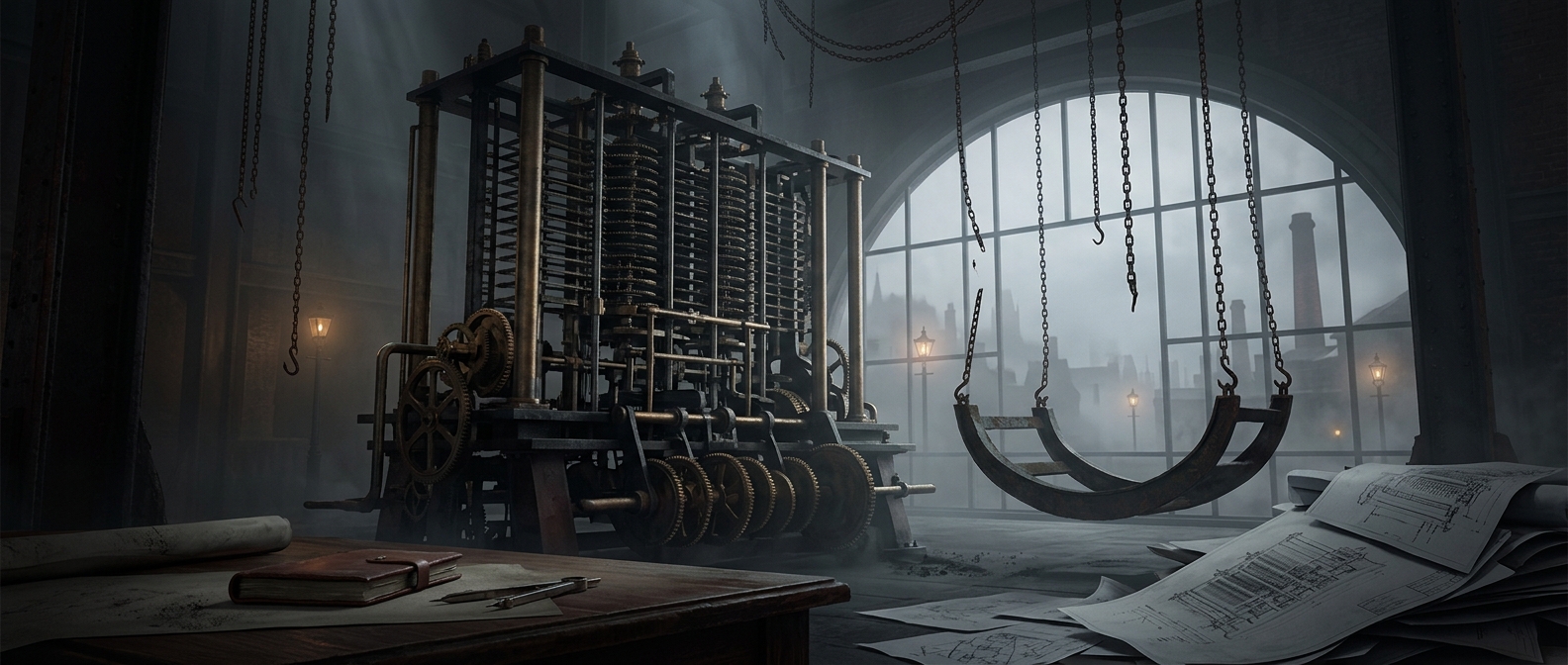
Turning that method into hardware required an enormous assembly of precisely shaped gears, shafts, and numbered wheels. Each part had to move in the right sequence, carry values correctly, and avoid binding against its neighbors. As the design changed, the engineering work changed with it. Babbage’s disagreements with his chief engineer added to the delays, and the original project was never completed in his lifetime.
That gap between idea and machine matters: the engine was not merely a drawing waiting to be copied. Its scale and precision made construction a major engineering undertaking, while changes to the plans made it harder to keep building steadily.
What the later build demonstrated
In 1991, the Science Museum in London completed a working Difference Engine based on Babbage’s designs. The build showed that the mechanical principles could be made to work with carefully manufactured parts, even though the original effort had stalled. The long delay therefore reflects both the ambition of Babbage’s design and the practical difficulty of turning intricate calculations into reliable machinery.
When the completed engine operates, its rows of wheels make arithmetic visible: a result emerges not from hidden electronic circuits, but from metal parts physically carrying numbers forward one step at a time.