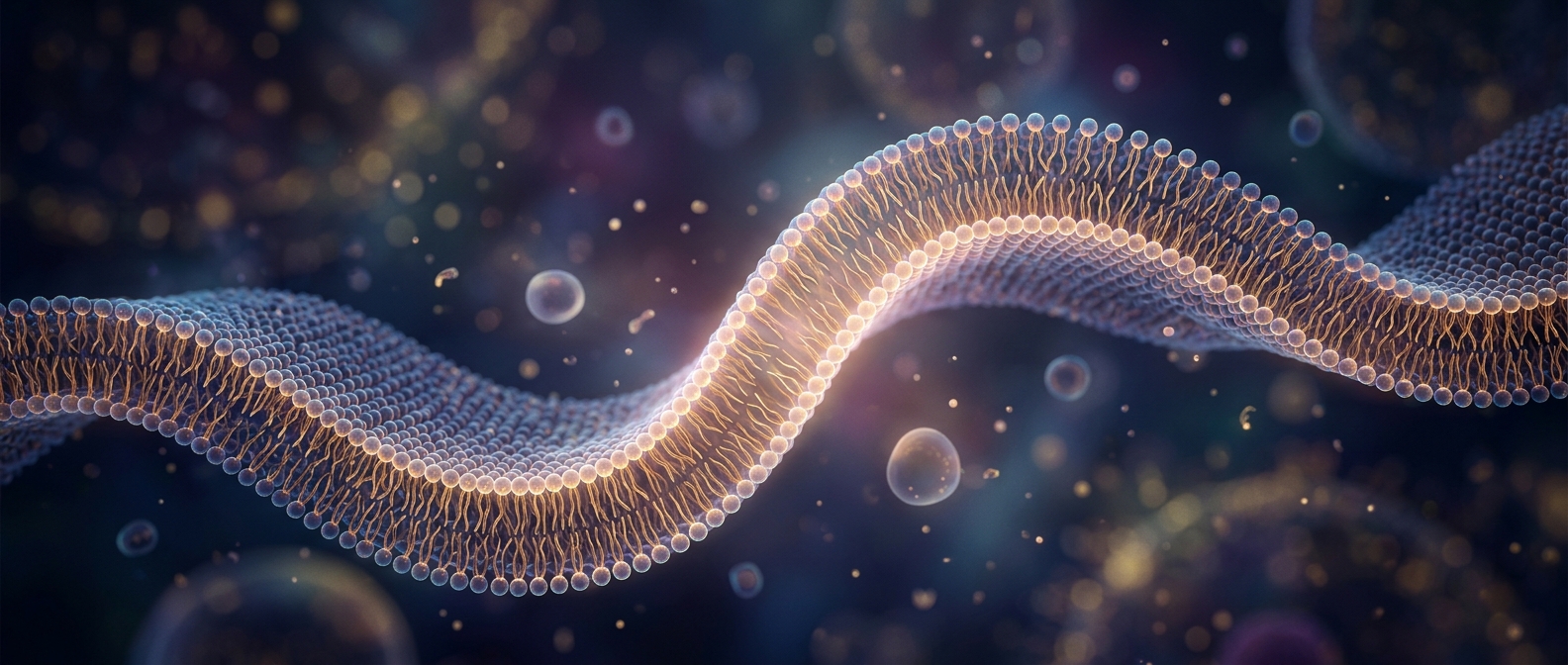
The Cell’s Flexible Boundary Is a Membrane
The thin, flexible layer described here is the cell membrane, not a cell wall. A membrane surrounds every cell. Many cells—such as those of plants, fungi, and bacteria—also have a sturdier wall outside it, but that wall is made of other materials and helps resist pressure and provide support.
The membrane’s basic framework is a double layer of phospholipids. Each molecule has a water-attracting head and water-repelling tails. Because the cell’s interior and its surroundings are watery, the heads face outward on both sides while the tails point inward, away from water. This arrangement forms a continuous barrier without requiring the cell to build a hard shell.
A Barrier That Can Bend and Control Traffic
The bilayer is flexible because its molecules can shift sideways, much as people in a crowd can rearrange without the crowd falling apart. That lets a cell change shape and helps small tears in the membrane close. The barrier is not simply a sheet of fat, however: proteins embedded in it help move selected substances across, receive signals, and carry out other tasks. The membrane is therefore both a boundary and an active interface with the cell’s surroundings.
That distinction matters when considering what keeps a cell intact. The membrane regulates exchange and separates the cell’s contents from the outside; a cell wall, where present, provides additional mechanical support. In a plant cell, for example, the wall can help the cell withstand internal water pressure, while the pliable membrane beneath it still governs what crosses the boundary.