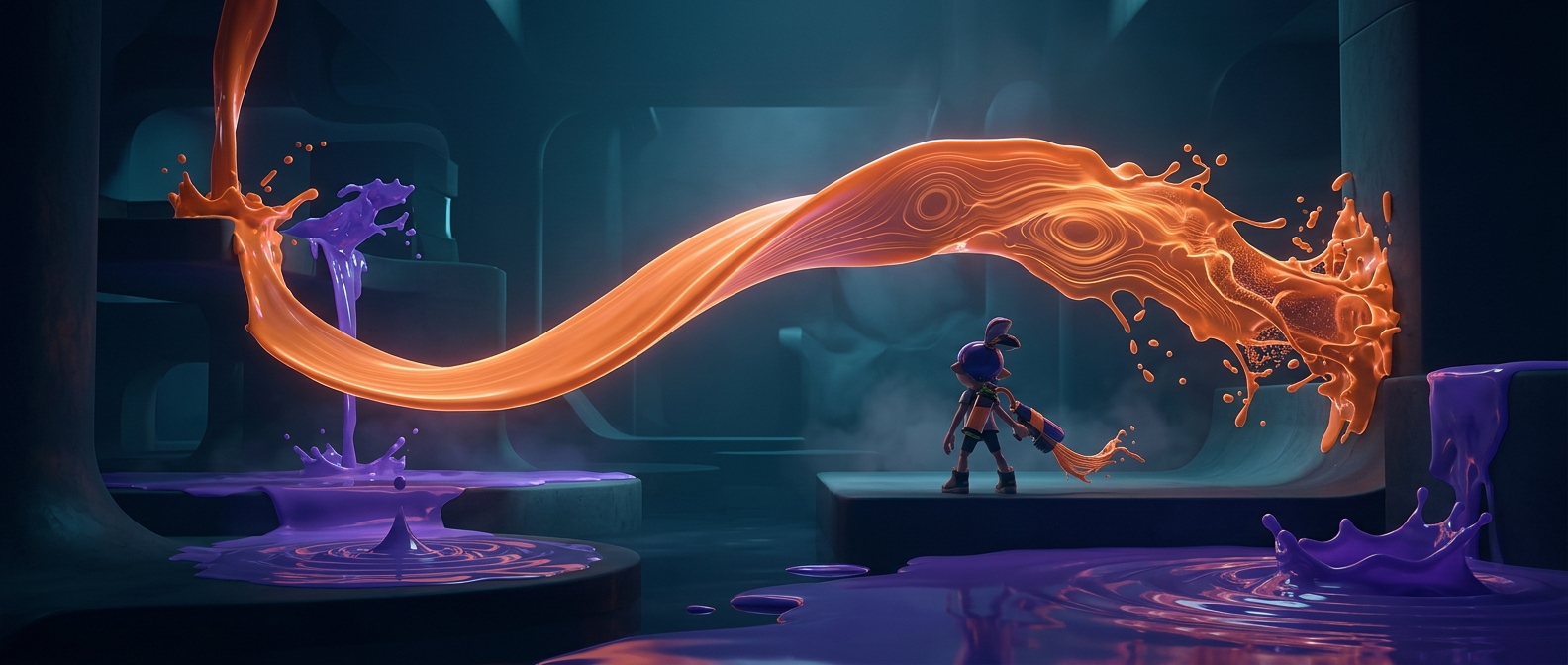
Ink Is a Volume, Not a Surface Effect
In Splatoon, ink is more than a colored coating drawn over the floor. The game tracks it as something with depth: a patch of ink occupies space above a surface, so it can behave like a medium a character enters rather than merely a texture the character stands on.
That distinction matters when an Inkling changes into squid form. The game can check the ink’s density at the character’s location—roughly, whether there is enough ink there to count as a swim-able volume. A patch that looks colored but is too thin or sparse need not function like a deep pool.
Why the Check Changes How Ink Feels
A density check gives the game a practical way to decide whether a character can submerge and move through ink. It also lets the visible coverage carry mechanical information: thick, connected ink can be a route, while bare ground or an insufficiently filled area interrupts that route.
This does not mean the game is calculating every detail of real liquid. A full physical simulation would be costly and unpredictable for a fast multiplayer action game. Instead, the useful part of fluid behavior is represented in a form the game can test reliably. The result is a small but consequential design choice: ink can look like a surface while still behaving, for movement purposes, like a space with depth.