How Tarot’s Number Cards Became Scenes
In many older tarot decks, the numbered cards of the minor arcana showed their suit symbols—cups, swords, wands, or coins—arranged in rows. A card might display five cups and little else. Readers had to draw much of its meaning from tradition, the card’s number and suit, and its position in a spread.
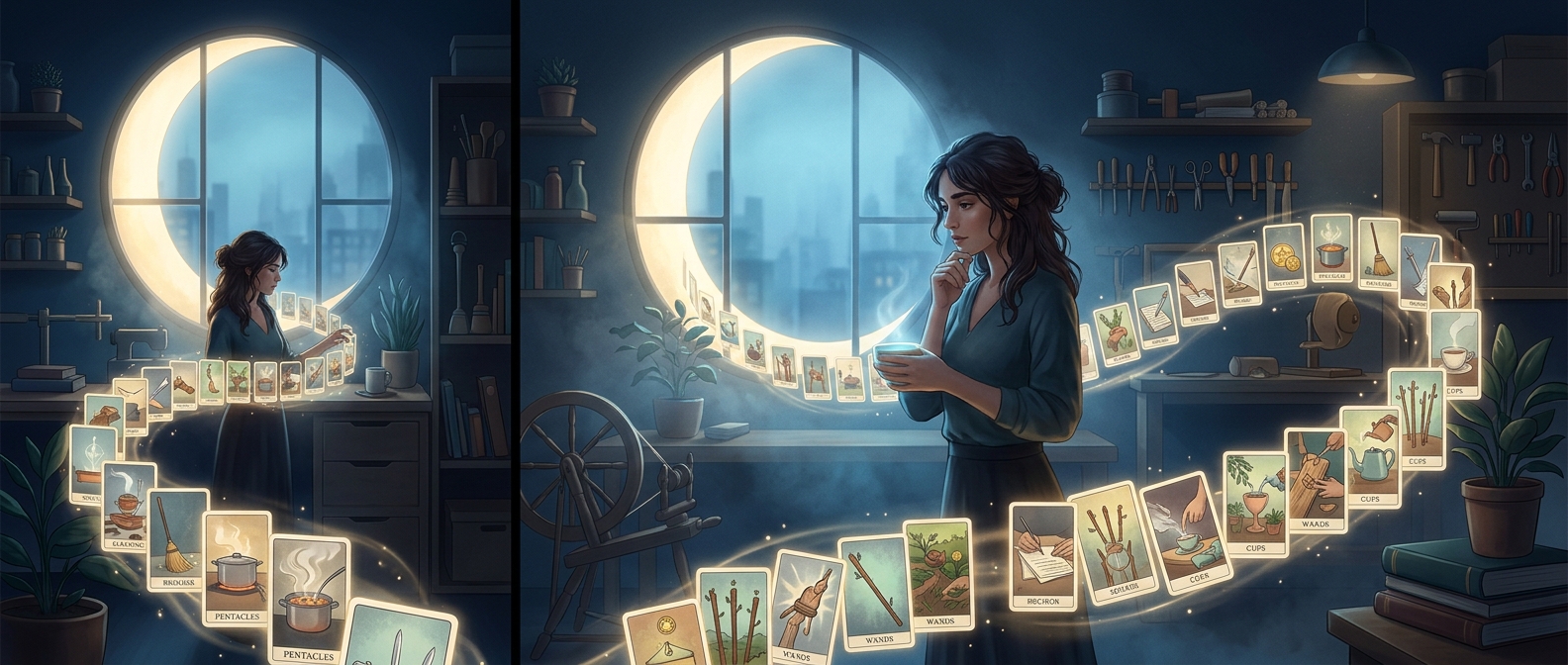
The Rider–Waite–Smith deck, first published in 1909, gave nearly every numbered minor card a small scene instead. The Three of Swords, for example, shows a heart pierced by three blades; other cards depict people working, celebrating, arguing, or traveling. The symbols became part of an imagined moment rather than a count to be decoded.
A Picture Adds Clues—and Choices
The scenes gave readers more visible details to interpret: a person’s posture, the weather, the objects nearby, or the action unfolding. That made the cards easier to approach without memorizing a bare list of suit-and-number meanings. It also gave readers room to connect an image to the question and surrounding cards in a spread.
The deck’s imagery was created by artist Pamela Colman Smith under the direction of occult writer A. E. Waite. Its lasting influence came not just from illustrating the cards, but from making a particular visual interpretation available for each one. Later deck-makers could borrow those scenes, adapt them, or deliberately depart from them.
The Template Outlived the Original Deck
Many modern tarot decks still use the Rider–Waite–Smith scenes as a visual starting point, even when their art style and symbolism differ. That inheritance means readers may recognize a card’s familiar story across very different-looking decks—and may also mistake one influential interpretation for an unchanging feature of tarot itself.
A simple row of suit symbols asks the reader to supply more of the scene. An illustrated card supplies one, and that difference helped shape how generations learned to read the minor arcana.